
Some links on this page are affiliate links. If you book through them, we may earn a commission at no extra cost to you.
The most useful number in Galápagos cruising is not the fare. It is the guide ratio. The national park sets a legal floor of one certified naturalist per 16 passengers, which is why so many vessels are built to carry exactly 16 people. The best operators run 1:10. That difference — six fewer people between you and the person who can tell a Nazca booby from a masked one — is what you are actually buying when you move up a tier.
The second most useful number is what the cruise fare leaves out. Within one company’s own fleet, one ship includes the park fee, the transit card and your domestic flights; its sister ships include none of them and charge for bottled water. Those omissions can swing the true cost by $800 a person.
The Mandatory Costs Nobody Puts in the Headline Price
| Cost | Amount | Detail |
|---|---|---|
| Galápagos National Park entrance fee | $200 adult | Doubled from $100 on 1 August 2024 — the first increase in about 25 years. $100 for children, free under 2. Paid in cash USD on arrival. |
| INGALA transit control card | $20 | All ages. Bought at the counter in Quito or Guayaquil before airline check-in. |
| Flights from mainland Ecuador | $250–$600 return | Quito or Guayaquil to Baltra (GPS) or San Cristóbal (SCY) |
| Crew and guide gratuities | $200–$400 per person | Roughly $20–30/day guide, $15–20/day crew, on an 8-day trip |
That is $600–$820 per person on top of the fare unless your operator includes it. A great deal of published content still quotes the old $100 park fee, so check the date on anything you read — including the brochure.
The Vessels, Ranked by What You Actually Get
Ecoventura — Origin, Theory and Evolve
The purest luxury-yacht proposition in the archipelago and the only Relais & Châteaux expedition yachts in the Galápagos. Each carries just 20 guests in 10 staterooms with 13 crew including two naturalist guides — a 1:10 ratio Ecoventura describes as the lowest in the islands.
2026: $10,950 per person for a stateroom, $21,900 for a suite, on the 8-day/7-night itinerary. 2027: $11,500 and $23,000. Holiday departures add $500.
Included: open bar with wine, beer and spirits; 24/7 satellite Wi-Fi; two guided excursions daily; two Zodiacs and a glass-bottom boat; kayaks and paddleboards; full 3mm wetsuits and snorkel gear. Excluded: the $200 park fee and the $20 transit card, plus all flights and gratuities.
Quasar Expeditions — M/Y Grace
Sixteen guests aboard a yacht formerly owned by Grace Kelly, Princess of Monaco — comfortably the best story in the fleet, and the Grace Kelly Suite is named for her. Four cabin tiers across two 8-day itineraries.
| Cabin | 2026 | 2027 | 2028 |
|---|---|---|---|
| Premium Stateroom | $10,950 | $11,500 | $12,000 |
| Twin Suite | $11,600 | $12,180 | $12,650 |
| Master Suite | $12,600 | $13,150 | $13,800 |
| Grace Kelly Suite | $13,900 | $14,600 | $15,400 |
Crucially, Quasar includes the park entrance fee and the transit card — unusual, and worth roughly $220 a head against competitors. Also included: wetsuits, kayaks, paddleboards and selected wine, beer and cocktails. Single supplement is 75% in suites, 50% elsewhere.
Silversea — Silver Origin
The most hotel-like luxury in the islands: purpose-built in 2020 for exactly 100 guests in 51 suites, with a crew of around 86–90, a 1:10 guide ratio, eight Zodiacs, ten kayaks and butler service in every suite — which Silversea claims is unique in the Galápagos.
Seven-night lead-in fares with taxes included run around $12,750–$12,900, with higher categories and holiday sailings from $24,100 to $39,820. The 10-day Outer Loop package starts at $12,900 and the Inner Loop at $11,900. Silversea has historically bundled round-trip economy air from mainland Ecuador, Quito hotel nights and the park and INGALA fees into its Galápagos packages — but confirm current inclusions directly, as its published detail has moved.
Aqua Expeditions — Aqua Mare
The genuine superyacht: 16 guests in seven suites, renovated in 2021, with a Category I Owner’s Suite of 80m² billed as the largest in the Galápagos and a crew ratio near 1:1. From $12,740 for 8 days/7 nights. Inclusions are the most generous in the fleet — selected premium wines and beer, laundry, high-speed Wi-Fi, group transfers, all excursions, and both the park fee and the INGALA card.
Metropolitan Touring — and the inclusion trap
This is the clearest illustration of why headline fares mislead. All three ships are run by the same company.
Santa Cruz II (90 guests, 50 cabins, nine bilingual naturalists — a 1:10 ratio) is the most inclusive mainstream product in the archipelago: the 2026 fare of $8,372 for 5 days or $11,105 for 7 days in an Explorer cabin includes the park entrance fee, the transit card, and economy return flights from Quito to Baltra, plus all meals with wine and beer at lunch and dinner.
Yacht La Pinta (48 guests, three naturalists) looks much cheaper at $5,987 for 5 days and $7,946 for 7. But it excludes the park fee, the transit card, all flights, all beverages including non-alcoholic ones, gratuities, a fuel surcharge and a carbon-neutral fee. Add those back and the gap to Santa Cruz II narrows dramatically.
Yacht Isabela II (40 guests, two guides) is the entry point at $4,341–$6,427 in 2026, with the same long exclusion list. Note the guide ratio drops to 1:20 at full capacity — below the stated park standard.
Celebrity, Lindblad and the rest
Celebrity Flora is a purpose-built 100-guest all-suite ship with “Infinite Veranda” suites; Xpedition carries 48 and Xploration just 16. Celebrity caps naturalist groups at 12 and includes the park fee, the tourist card, all onboard drinks and gratuities, snorkel gear, mini-wetsuits, binoculars and unlimited Wi-Fi. Flights are included only on packages of 10 nights or more, not on the 7-night cruise. Celebrity does not publish per-person fares on its own pages.
Lindblad / National Geographic runs Islander II (48 guests, 1:1 guest-to-crew), Endeavour II (96), Gemini (48, with dedicated solo cabins) and the 16-guest catamaran Delfina. Its distinguishing practice: guests are not assigned to fixed guide groups and rotate freely. Fares start at $6,460 for a 7–8 day Galápagos Escape and $6,370 for the 10-day Exploring Galápagos, with the Delfina from $15,222. The park fee and transit card are included; Galápagos flights are not.
Why Your Itinerary Is Fixed — and Which Loop to Choose
You cannot design a Galápagos cruise. Every operating permit is issued by the national park with a specific itinerary attached, dictating which visitor sites a vessel may enter each day, for how long, and what you may do there. Since 2012 a vessel must wait roughly a fortnight before returning to the same site. So every ship runs a two-week master route that operators slice into 4-, 5-, 6- and 8-day segments — which is also why two consecutive 8-day departures visit entirely different islands.
- Western (Isabela, Fernandina): the youngest, still volcanically active islands. Flightless cormorants, Galápagos penguins, marine iguanas, humpback whales around Isabela. The most dramatic landscapes and the longest open-water legs.
- Eastern/Southeastern (Española, San Cristóbal, Genovesa): waved albatross on Española, red-footed boobies at Punta Pitt and on Genovesa. San Cristóbal is among the oldest islands at over four million years.
- Northern (Genovesa): red-footed and Nazca boobies, great frigatebirds, storm petrels. Remote, and only on longer itineraries.
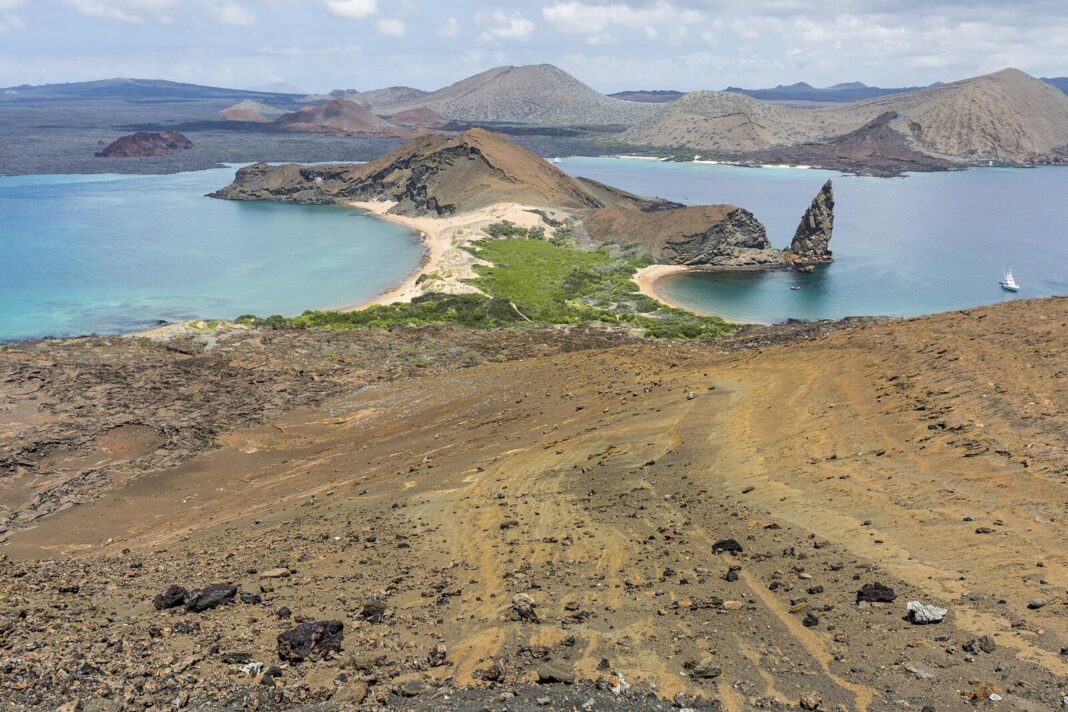
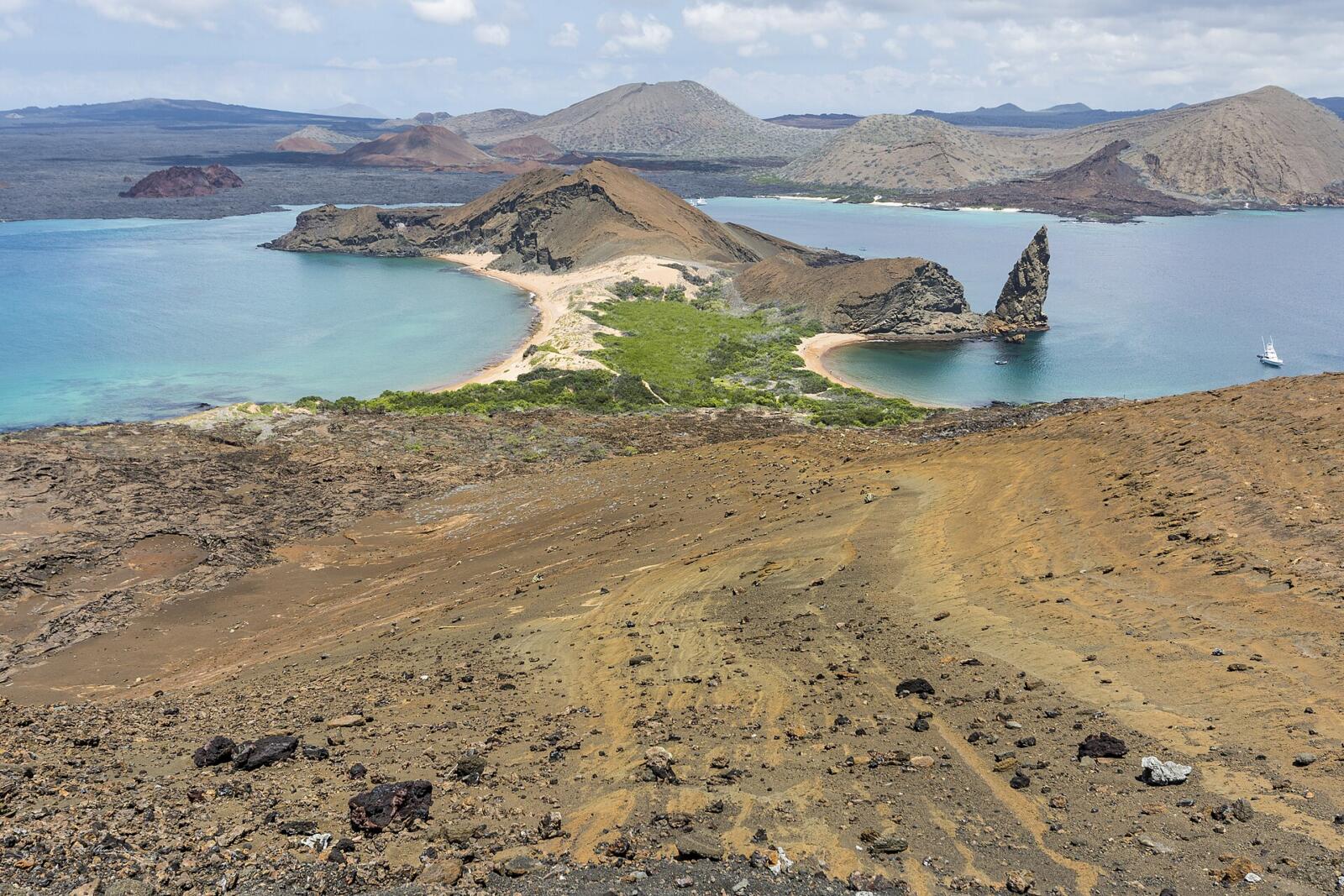
- Central (Santa Cruz, Bartolomé, North Seymour, South Plaza): where the 4-day itineraries concentrate. Blue-footed boobies, land iguanas, the Pinnacle Rock snorkel and the Charles Darwin Research Station.
For first-timers, take the 8-day/7-night itinerary. It covers roughly half the archipelago including the remote northern, southeastern and western islands. Four-day trips stay central and skip the signature endemics.
One correction worth making: whale sharks are not a feature of western naturalist cruises. They aggregate at Darwin and Wolf islands in the far north, which are closed to naturalist itineraries and accessible only on dedicated dive liveaboards, June to November. No luxury cruise can promise you one.
When to Go
Warm and wet, roughly December to May. Air temperatures reach about 30°C, sea temperatures 23–25°C, and snorkelling is comfortable, sometimes without a wetsuit. Brief heavy afternoon showers; March is the hottest and wettest month. Calm seas and the best underwater visibility. Green turtles most active; blue-footed booby courtship from May.
Cool and dry — the garúa season, roughly June to November. Air 15–22°C with persistent morning mist that usually burns off by midday. Sea temperatures somewhere between 16°C and 22°C depending on which source you trust, so bring or rent a wetsuit. Seas are roughest July to October. The Humboldt upwelling makes this the better season for big marine life and diving.
Key windows: waved albatross on Española court from April through mid-December, with thousands laying eggs in May and chicks fledging in December. Humpbacks from June near Isabela and Fernandina. Sea lion pups are at their best in November.
Prices peak June to August and again at Christmas and New Year, when every operator applies an explicit surcharge. September and October are the best value, with some vessels in dry dock and discounted rates; November combines strong weather and wildlife with relatively few visitors.
Cruise or Land-Based?
Land-based island-hopping — Pikaia Lodge on a volcano rim, Finch Bay, Royal Palm — lets you avoid nights at sea entirely, which genuinely matters for the seasickness-prone and families with young children.
But understand the constraint: day boats from Puerto Ayora cannot reach the remote sites. Genovesa, Española, Fernandina and the far west are only reachable on 8-day cruise itineraries.
And at the luxury tier it is not a saving. Pikaia Lodge runs from $4,680 per person for 4 days/3 nights — about $1,560 a night. Ecoventura’s 2026 stateroom works out at roughly $1,564 a night. The case for land-based luxury is comfort, flexibility and a stable floor. It is not price.
Practical Notes
There are no direct international flights to the Galápagos. Fly into Quito (UIO) or Guayaquil (GYE), then connect to Baltra (GPS) or San Cristóbal (SCY) — about 2.5 hours from Quito (most of which stop in Guayaquil) or 1.5 from Guayaquil, on Avianca or LATAM. Arrive in Ecuador at least a day early. Delays are common and the ship will not wait.
Watch the transfer conditions: several operators tie group transfers to one specific flight. Ecoventura’s airport assistance covers AV1630 arrivals only; Aqua Mare’s transfers apply to “the recommended flight.” Booking off-flight can forfeit them.
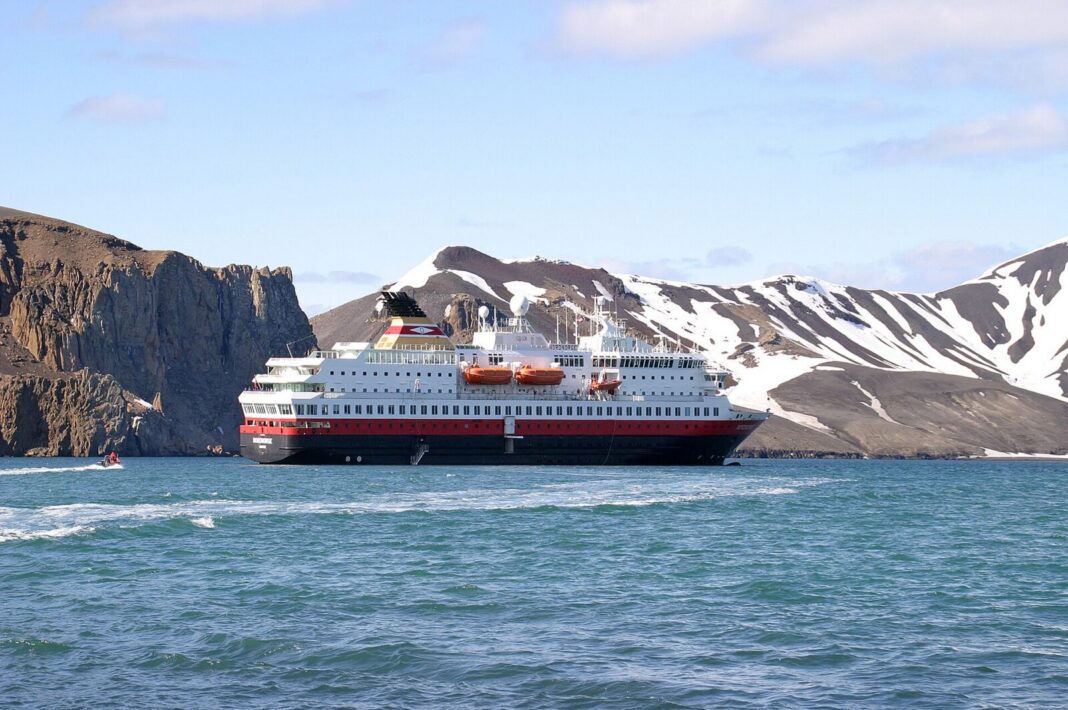
On ship size: the park caps vessels at 100 passengers and limits the number of permits. Before 2010 only locally owned Ecuadorian companies could operate; when that restriction lifted, Celebrity, Silversea and Hurtigruten entered — all with 100-passenger ships. That ceiling is why “the biggest luxury ship in the Galápagos” tops out at 100 guests.
On seasickness, the catamaran-versus-monohull debate is not settled. Naval architects consulted on the question say it depends on speed, hull form and angle to the waves. In the short seas typical of the islands, monohulls tend to roll and catamarans tend to pitch. One operator’s guest survey found about 92% were “hardly or not at all” bothered.
Frequently Asked Questions
How much does a luxury Galápagos cruise cost?
Expect $10,950–$15,500 per person for an 8-day luxury cruise in 2026-27, with suites running to $23,000. Add $600–$820 for the park fee, transit card, flights and gratuities unless your operator includes them.
How much is the Galápagos park entrance fee now?
$200 for foreign adults and $100 for children, paid in cash USD on arrival. It doubled from $100 on 1 August 2024. The separate INGALA transit control card is $20 for all ages.
What is the best Galápagos cruise for a first-timer?
An 8-day/7-night itinerary on a vessel of 20–100 guests with a 1:10 guide ratio. Ecoventura, Quasar’s Grace, Silver Origin and Santa Cruz II all qualify at different price points.
What is the best time of year to visit the Galápagos?
December to May for calm seas, warm water and the best snorkelling. June to November for big marine life, cooler air and fewer crowds. September to October offers the best value; June to August and the Christmas period are the most expensive.
Can I see whale sharks on a Galápagos cruise?
Not on a naturalist cruise. Whale sharks aggregate at Darwin and Wolf islands from June to November, and those sites are accessible only to dedicated dive liveaboards.
Is a Galápagos cruise better than staying in a hotel?
For wildlife, yes — day boats cannot reach the remote islands. For comfort and flexibility, land-based works well, but at the luxury tier it costs roughly the same per night.
The Bottom Line
Compare total cost, not fare. Build a column for the $200 park fee, the $20 transit card, mainland flights and gratuities, then see which ships have already absorbed them — Santa Cruz II, Quasar’s Grace, Aqua Mare and Celebrity have; La Pinta, Isabela II and Ecoventura have not.
Then compare guide ratios. One naturalist per 16 guests is the legal minimum. One per ten is what the money is for.
If you are weighing this against other small-ship options, our comparison of Regent vs Silversea vs Seabourn and our guide to the best luxury cruise packages cover the wider field.
Fares are lead-in pricing for the 2026 and 2027 seasons, dated October 2026, and most per-cabin rates here come from authorised resellers rather than operator sites. Inclusions vary sharply between vessels, even within one fleet. Verify current fares, inclusions and the park fee with the operator before booking. Imagery via Wikimedia Commons, credited individually.