
Some links on this page are affiliate links. If you book through them, we may earn a commission at no extra cost to you.
The purchase price of a private jet is the number everyone asks about and the one that matters least. A Citation CJ3 Gen2 lists at roughly $11.7 million in 2026. Flying it 200 hours a year will cost you another $1.17 million annually before you have paid a cent of the principal — and that figure does not include depreciation, sales tax, or the pre-buy inspection that stands between you and the keys.
This is the full accounting: what aircraft actually cost new and used in 2026, what they cost to run, what the acquisition itself adds, and the honest answer to whether ownership beats chartering. If you are earlier in the decision, start with our breakdown of private jet charter cost in 2026 — most people who ask this question should charter instead.
The Short Answer
| Category | New (2026) | Typical pre-owned | Annual cost at 200 hrs |
|---|---|---|---|
| Very light jet | $3.5M–$7.6M | $690K–$5.5M | ~$900K |
| Light jet | $11.7M–$14.3M | $255K–$12.4M | ~$1.17M |
| Midsize | $18.2M–$22M | $879K–$19.8M | ~$1.50M |
| Super-midsize | $25M–$30M | $1.9M–$25.9M | ~$1.8M |
| Large cabin | $35.5M–$38.3M | $1M–$34.3M | ~$2.40M |
| Ultra-long-range | $50M–$85M | $8.5M–$81.9M | $3M+ |
Category boundaries vary between sources — one publisher’s “large cabin” is another’s “heavy” — so treat the bands as orientation and the named aircraft below as the real data.
New Aircraft Prices by Category, 2026
The figures below come from Aviation Week’s 2026 Purchase Planning Handbook data as published by cost-model provider FlyCraft, checked in October 2026. Treat them as typically equipped prices: a green aircraft plus a standard completion. Options, custom interiors and connectivity push real transaction prices higher.
Very light and light jets
| Aircraft | 2026 price |
|---|---|
| Cirrus Vision Jet G3 (SF50) | $3.5M |
| Embraer Phenom 100EX | $5.8M |
| Cessna Citation M2 Gen2 | $7.0M |
| HondaJet Elite II | $7.6M |
| Cessna Citation CJ3 Gen2 | $11.7M |
| Cessna Citation CJ4 Gen2 | $12.8M |
| Embraer Phenom 300E | $13.4M |
| Pilatus PC-24 | $14.3M |
One correction worth making, because it still circulates: there is no Learjet in production. Bombardier ended the line in 2022 and has not replaced it. Learjets appear in this market only as used aircraft.
Midsize through ultra-long-range
The Cessna Citation Ascend lists at $18.2M and the Embraer Praetor 500 at $21.6M. Super-midsize runs roughly $25M–$30M; for reference, 2023 list prices put the Bombardier Challenger 3500 at $27.2M, the Citation Longitude at $30.0M and the Gulfstream G280 at $24.5M.
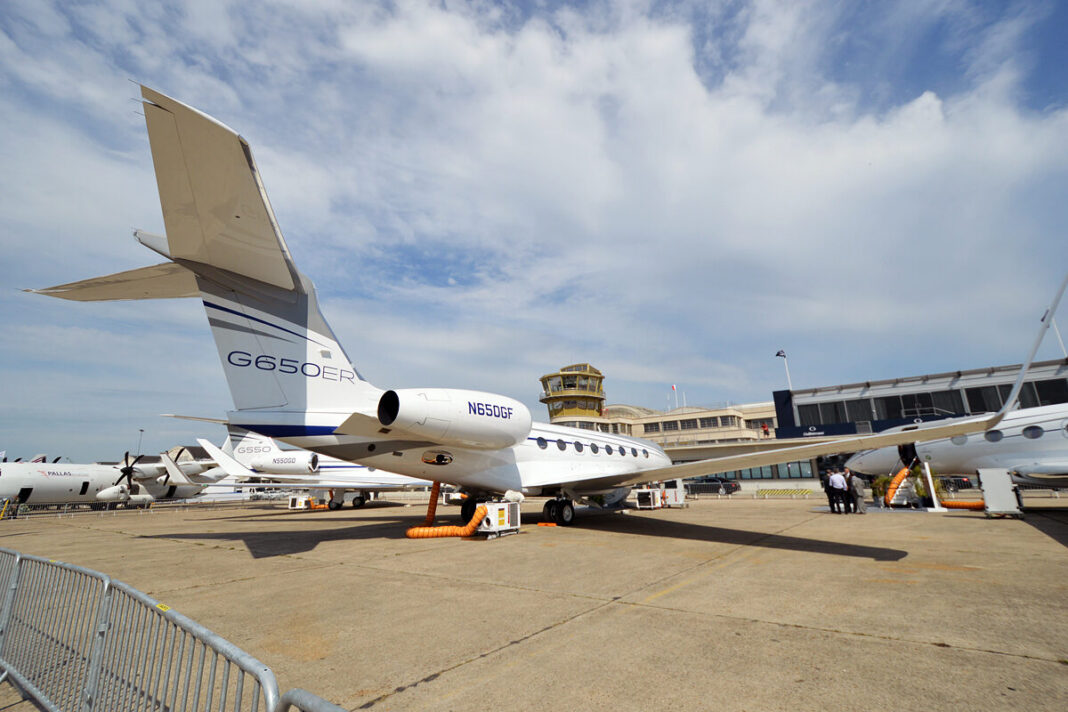
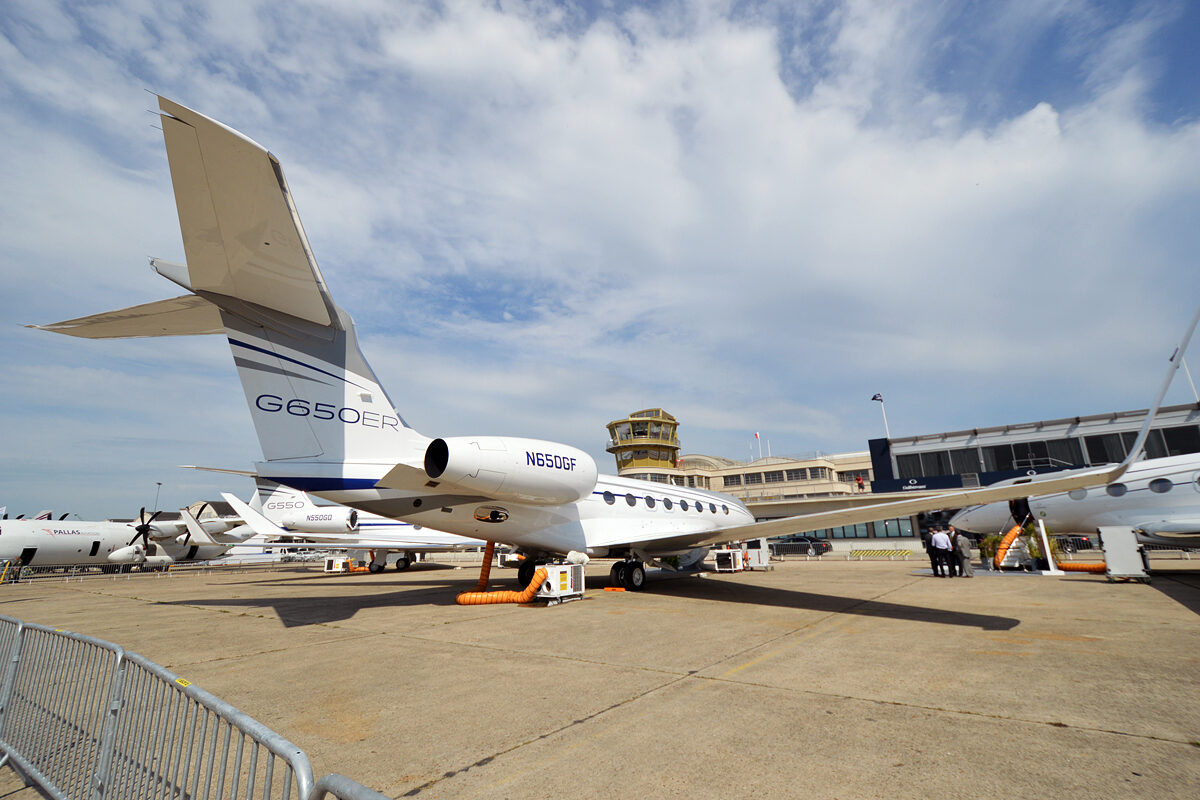
At the top: the Gulfstream G700 is $84.9M and the G800 $80.4M in 2026, with the Bombardier Global 8000 around $85M. Gulfstream’s own equipped prices from 2023 put the G650 at $68.5M and the G650ER at $70.5M, and Dassault’s Falcon 6X at $53.8M. The Falcon 10X has not entered service — it was due to fly in 2026 with service entry around 2027 — so any 10X price you see quoted is speculative.
Above that sit the bizliners: Embraer Lineage, Airbus ACJ TwoTwenty and Boeing BBJ variants, which run from roughly $80M to $120M green, before a completion that can add tens of millions and 18 months. We cover that end of the market in the most expensive private jets in the world.
The Pre-Owned Market in 2026 — And Why “Just Buy Used” Is Weaker Advice Than It Sounds
The conventional wisdom is that a used jet saves you 30–50% against new. In 2026 that is true for old metal and emphatically untrue for anything young and in demand.
JETNET’s mid-2026 data put just 6.6% of the fleet for sale, against a pre-pandemic norm of 9–12%. Average days on market reached 98, up 5.6% year on year. The critical number: 74% of the aircraft for sale are 16 years or older, up from 60% in 2019. The inventory that exists is largely aging airframes; young, low-time aircraft barely reach the market at all.
What that does to prices is striking. GlobalAir reported in September 2026 that a 2024 Citation CJ4 Gen2 sold for $12.5 million — more than Textron’s fully equipped list price — and that seven-year-old Phenom 300Es were asking $13.75M and $14.75M against a 2023 new list of $10.995M. Used CJ4 Gen2s averaged $13.2M with just seven listings worldwide and 144 days on market.
Older aircraft are a genuinely different story. Light jets from the 1970s–1990s trade cheaply: a Learjet 35A at $525K–$960K, a Citation II at $692K–$1M, a Hawker 400XP at $1.2M–$1.6M. The catch is that a $700,000 airframe does not come with $700,000 operating costs. Crew salaries, hangar and insurance are essentially the same whatever you paid, and maintenance and downtime are worse.
Two major trackers disagree on direction, so be careful with any single headline. JETNET recorded 1,115 whole-aircraft transactions in H1 2026, down 10.8% year on year. AMSTAT reported Q2 2026 business jet transactions up 15.5%, with heavy jets up 43.8%. Different periods and different methodologies; both show asking prices falling fastest at the large-cabin end.
What It Costs to Run
These are median 2026 figures from FlyCraft’s cost model, built on a 200-hour year with fuel at $7.66 a gallon.
| Annual fixed cost | Light | Midsize | Large |
|---|---|---|---|
| Crew pay (incl. benefits) | $311,079 | $411,881 | $704,897 |
| Recurrent training | $38,000 | $33,000 | $73,000 |
| Hangar | $39,270 | $46,650 | $62,670 |
| Insurance | $13,913 | $16,700 | $39,000 |
| Management | $45,000 | $60,000 | $114,000 |
| Other fixed | $40,000 | $50,000 | $80,000 |
| Total fixed | $487,262 | $618,231 | $1,073,567 |
| Variable cost per flight hour | Light | Midsize | Large |
|---|---|---|---|
| Fuel | $1,490 | $1,923 | $2,696 |
| Maintenance | $800 | $1,050 | $1,750 |
| Engine reserve | $600 | $700 | $1,000 |
| Fees and crew travel | $400 | $525 | $825 |
| Other | $113 | $150 | $300 |
| Total per hour | $3,373 | $4,348 | $6,637 |
All-in at 200 hours a year: roughly $1.17M for a light jet, $1.50M midsize, $2.40M large cabin. Fly a large-cabin aircraft 400 hours and $4M a year is realistic.
Two line items deserve a warning. Engine programs — JSSI, Rolls-Royce CorporateCare, Pratt & Whitney ESP, Honeywell MSP and the OEM equivalents — do not publish rates. They are quoted per tail, and the only publicly posted rates in the market are Pilatus CrystalCare at $4,799/month plus $380/hour for a PC-12 and $17,226/month plus $820/hour for a PC-24. Anyone quoting you a generic program rate is guessing. Second, if you are not on a guaranteed hourly program, budget $1M or more per engine for overhaul on a large-cabin jet, and $1.2M–$2M for paint and interior every seven to nine years.
The Costs Around the Purchase
Pre-purchase inspection: $15,000–$50,000 for a business jet, depending on type and scope. Expect two to four weeks end to end and three to seven days of physical inspection, covering logbook analysis, borescope of engines and APU, systems testing and a maintenance forecast. Do not economise here. Missing logbooks alone can cut appraised value by 10–20%, and up to 30% on complex aircraft.
Acquisition fees: 3–5% of purchase price for a broker or acquisition consultant on larger aircraft.
Sales and use tax is the biggest avoidable line item, and it is enormous. On a $20M midsize jet, California’s combined rates of roughly 7.25%–11.25% mean $1.45M–$2.25M. Texas is 6.25% with a fly-away exemption available. North Carolina caps aircraft tax at a flat $2,500 regardless of price. Delaware, New Hampshire, Massachusetts, Oregon and Rhode Island levy none, and New York broadly exempts noncommercial civil aircraft.
Fly-away exemptions have hard windows — ten days in Kansas and Nebraska, 60 days in Virginia and West Virginia, 90 in Idaho, 120 in Colorado — and documentation generally has to be completed at the time of sale, not retroactively. Use tax catches the rest: California presumes an aircraft brought into the state within 12 months of an out-of-state purchase was bought for California use, and the burden of proof falls on you.
Financing: expect 80–85% loan-to-value on new aircraft, 70–75% on old airframes, terms of 15–20 years on modern types, and lenders capping age plus term at roughly 23–25 years for turbines. Tier-one underwriting typically wants 12–18 months of debt service in post-close liquidity.
The Break-Even: Own or Charter?
Five independent sources converge on the same band. Below roughly 150–200 hours a year, chartering is cheaper. Between 200 and 300 hours you are in the grey zone where a jet card or fractional share usually wins. Above 300–400 hours, ownership starts to pay. Light jets cross over nearer 200–250 hours; large-cabin aircraft nearer 300–400.
The arithmetic at low utilisation is brutal: 100 hours of chartered light-jet flying runs roughly $250,000–$350,000, while owning the same aircraft for 100 hours costs $400,000–$600,000 in fixed costs alone, before you burn a gallon.
Why the hours rule of thumb is incomplete
- Depreciation is excluded from most break-even math. Plan on 5–10% a year. On a $20M aircraft that is $1–2M annually — enough to swamp the operating comparison on its own.
- Buying used does not cut fixed costs. Crew and hangar are unchanged; maintenance and downtime get worse.
- Downtime means paying twice. During heavy maintenance you still charter.
- Owners never get empty legs. Charter customers do. Our guide to empty leg flights covers that discount.
- Opportunity cost. Twenty million dollars parked in a depreciating asset is twenty million not invested.
- The tax tail can wag the dog — see below — which is why the hours test alone is not decisive for a qualifying business buyer.
If you land in the 150–300 hour band, the realistic options are a jet card program or fractional ownership, and the NetJets versus Flexjet comparison is the natural next read. We also run the numbers directly in private jet membership vs charter.
Depreciation and Tax: What Changed in 2025
This is where most articles on the internet are now wrong. Under the Tax Cuts and Jobs Act phase-down, bonus depreciation was scheduled to fall to 20% in 2026 and zero in 2027. A great deal of published content still says exactly that.
It was superseded. The One Big Beautiful Bill Act, signed 4 July 2025, permanently restored 100% bonus depreciation under IRC §168(k), with no scheduled phase-out. It applies to qualifying aircraft placed in service on or after 20 January 2025, with eligibility also conditioned on a binding acquisition contract signed on or after that date — so long-lead orders placed after January 2025 can qualify even when they deliver years later. New and used property both qualify, provided the buyer has not previously used the aircraft and it does not come from a related party.
The conditions matter as much as the headline:
- Aircraft are listed property under §280F. Qualified business use must exceed 50% of total hours, and unrelated-party business use must be at least 25%.
- If business use falls to 50% or below after the placed-in-service year, you recompute under straight-line ADS and recapture the excess as ordinary income.
- If foreign use exceeds 50% in a year, bonus depreciation is disallowed for that year.
- MACRS recovery is five years for Part 91 aircraft, seven for Parts 135/121.
Section 179 is largely a red herring at these prices: the 2026 indexed cap is $2,560,000, with phase-out beginning above $4,090,000 of qualifying purchases and complete at $6,650,000. For a multi-million-dollar jet, 100% bonus depreciation is the operative provision.
None of this is tax advice, and the interaction between entity structure, state tax and §280F is genuinely complicated. Engage an aviation tax specialist before you sign anything.
The 2026 Market in Context
Demand is strong. GAMA reported 383 business jet deliveries in the first half of 2026, up 8.2%, with total airplane billings of $14.3 billion, up 15.5%. Order books are deep: Bombardier’s backlog reached $21.8 billion at the end of Q2 2026 and Gulfstream’s $24.0 billion, with both targeting around 157–160 deliveries for the year.
New metal arriving or ramping in 2026 includes the Citation Ascend (the first flat-floor examples entered service with NetJets in May 2026), the Citation CJ4 Gen3, the Citation M2 Gen2 Autothrottle Edition and the Global 8000. The Gulfstream G400 is less certain — some outlets list 2026 deliveries, but General Dynamics CEO Phebe Novakovic has said the company is “no longer in the business of estimating EIS, given that the regulators set the pace.” Treat the G400 timeline as open.
Frequently Asked Questions
How much does it cost to buy a private jet?
New aircraft run from about $3.5 million for a Cirrus Vision Jet to $85 million for a Gulfstream G700 or Global 8000, with bizliners above $100 million. Used light jets from the 1980s and 1990s can be found under $1 million. The purchase price is typically the smaller part of total cost of ownership.
What is the cheapest private jet you can buy?
On the used market, older light jets such as the Dassault Falcon 10 ($255K–$395K) and Learjet 35A ($525K–$960K) are the cheapest entry points. New, the Cirrus Vision Jet G3 at around $3.5 million is the least expensive jet in production. Neither is cheap to operate.
How much does it cost to maintain a private jet per year?
At 200 flight hours a year, budget roughly $1.17 million for a light jet, $1.50 million for a midsize and $2.40 million for a large-cabin aircraft, all in. Fixed costs — crew, hangar, insurance, management — account for 40–60% of that and do not fall when you fly less.
How many hours a year do you need to fly to justify buying a jet?
The industry rule of thumb is 200–300 hours. Below 150–200 hours, chartering is almost always cheaper. Light jets cross over nearer 200–250 hours, large-cabin jets nearer 300–400.
Is bonus depreciation still available for aircraft in 2026?
Yes. The One Big Beautiful Bill Act permanently restored 100% bonus depreciation for qualifying aircraft placed in service on or after 20 January 2025. Content citing a 20% rate for 2026 is referring to the superseded TCJA phase-down.
Do private jets hold their value?
Generally no — plan on 5–10% depreciation a year. But the 2026 market is an exception at the top of the light-jet segment, where scarce in-demand models such as the Citation CJ4 Gen2 and Phenom 300E have traded at or above new list price.
The Bottom Line
If you fly fewer than 200 hours a year, buying a jet is a lifestyle decision, not a financial one — and that is a perfectly honest reason to do it, as long as you are clear that is what you are doing. If you fly more than 300, the numbers start to work, particularly with 100% bonus depreciation now permanent for qualifying business use.
What you should not do is budget the purchase price and treat the rest as detail. On a $12 million light jet flown 200 hours a year, the running costs over a decade exceed the aircraft. Price the second number first.
Aircraft prices, operating costs and market data change continuously, and the figures here are dated to October 2026. Verify current pricing with the manufacturer or a broker, and consult an aviation tax specialist before relying on any tax treatment described above. Aircraft imagery via Wikimedia Commons, credited individually.