
Updated 2 November 2026.
There is a version of the best time to visit Switzerland that every guide repeats: come in summer for the hiking, winter for the skiing, and October for the shoulder season, when the crowds thin out and everything is still open.
The crowd part is right. The “everything is still open” part is wrong, and expensively so. From roughly 19–26 October, Switzerland closes for maintenance — not metaphorically, but in a coordinated annual shutdown that takes out cable cars, funiculars, mountain restaurants and an entire panoramic railway. The Glacier Express does not run at all from 11 October to 4 December 2026. Grindelwald First closes for a month. Männlichen and Allmendhubel close for nearly two. Glacier 3000 closes. The Bernina Express is diverted.
Then it happens again in spring, after about 26 April.
Switzerland does not have two seasons with shoulders between them. It has two seasons with gaps between them, and knowing precisely where those gaps fall is worth more than any amount of general advice about weather. This guide is built on MeteoSwiss data, Federal Statistical Office hotel figures and the operators’ own published timetables.
The short answer
- Hiking and the high passes: late June through September. Not late May — in 2026 three major passes did not open until 29 May and two were still shut.
- Skiing: mid-December through early April, with the signature high-altitude terrain opening weeks after the first lifts.
- The gaps to avoid: roughly 19 October to late November, and 26 April to late May.
- Best value: November is the deepest trough of the year — but it is cheap because so much is closed.
- Best compromise: late September to mid-October, before the maintenance window opens. Larches turning, harvest in, lifts still running.
The two peaks, the two troughs
Swiss hotels recorded 43,930,146 overnight stays in 2025, a record, up 2.6%. The monthly shape is unusually clear:
| Month | Overnight stays | vs 2024 |
|---|---|---|
| January | 3,198,449 | +3.8% |
| February | 3,357,762 | −2.9% |
| April | 2,907,357 | +4.7% |
| June | 4,164,932 | +2.1% |
| July | 4,936,565 | +3.3% |
| August | 4,985,072 | +3.4% |
| September | 4,125,616 | +2.3% |
| October | 3,479,713 | +4.3% |
| November | 2,375,671 | −0.7% |
| December | 3,563,277 | +6.8% |
Summer peaks in August; winter peaks in December. The two troughs are November and April — and August runs 2.10× November and 1.71× April. The November trough sits 52% below the August peak.
Note the year-on-year column: in a record year, November was the only month that fell. April, October and December grew fastest. The shoulder seasons are growing and the dead month is getting deader — because, as below, there is progressively less open in it.
For context on the audience: overnight stays from the Americas reached 4.9 million in 2025, up 6.3%, with the United States accounting for about three quarters of that and representing the single largest-increasing country of origin.
The maintenance calendar nobody publishes
This is the most practically valuable section of this guide. Every date below comes from the operator’s own timetable.
Autumn 2026
| Closed for maintenance | Dates |
|---|---|
| Glacier Express (entire route) | 11 October – 4 December 2026 |
| Zermatt, Matterhorn Alpine Crossing | 7 September – 23 October 2026 |
| Zermatt, Matterhorn Glacier Ride I (3S gondola) | 28 September – 30 October 2026 |
| Glacier 3000 (Gstaad / Les Diablerets) | 19 October – 6 November 2026 |
| Allmendhubel funicular (Mürren) | 19 October – 11 December 2026 |
| Grindelwald First cable car | 26 October – 27 November 2026 |
| Männlichen (Grindelwald / Wengen) | 26 October – 11 December 2026 |
| Grütschalp (Lauterbrunnen–Mürren) | 26 October – 6 November 2026 |
| Eiger Express | 9 – 20 November 2026 |
| Bernina Express (diverted via Vereina) | 29 October – 13 November 2026 |
| Diavolezza | 16 November – 18 December 2026 |
| Schynige Platte railway | Closes 25 October, shut all winter |
| Harder Kulm | Closes 29 November, shut all winter |
Spring 2027
- Verbier: the Châble–Verbier cable car — the main access lift to the resort — closes 26 April to 23 May 2027. Four weeks.
- Zermatt: Matterhorn Glacier Ride I in revision 26 April – 21 May 2027.
- Zermatt: the Sunnegga funicular closes from 12 April 2027 for a control-system conversion.
- Oeschinensee cable car (Kandersteg): maintenance from mid-March to the beginning of May.
In short: in the roughly four weeks after 19–26 October 2026, and the roughly four weeks after 26 April 2027, at least ten named lifts and cableways across Gstaad, Verbier, Zermatt, Mürren, Grindelwald, Wengen, Kandersteg and the Engadine are shut, and the Glacier Express does not run for eight weeks.
Altitude is the whole story
Swiss weather is less about the month than about how high you are standing. MeteoSwiss normals for 1991–2020, computed from the official homogeneous station series:
| Station | Altitude | Jan mean | Jul mean | Annual precip |
|---|---|---|---|---|
| Lugano | 273 m | 38.8°F | 72.7°F | 1,567 mm |
| Geneva | 411 m | 35.7°F | 69.0°F | 946 mm |
| Zurich | 604 m | 33.7°F | 66.1°F | 1,108 mm |
| Zermatt | 1,638 m | 24.9°F | 56.6°F | ~640 mm |
| Samedan (St. Moritz basin) | 1,709 m | 16.9°F | 54.2°F | 710 mm |
| Jungfraujoch | 3,571 m | 9.4°F | 32.6°F | — |
Three things in that table are worth isolating.
Lugano is not the dry Mediterranean option. It is the warmest station and by far the wettest — 1,567 mm a year against Geneva’s 946, with 158–178 mm in every summer month and 167 mm in November. Zermatt, at 1,638 m, is one of the driest inhabited places in Switzerland at around 640 mm, less than half Lugano’s total. February is Zermatt’s driest month. Cold, dry and sunny, not snowy-wet.
Jungfraujoch is below freezing almost all year. Its warmest month, August, averages a high of 38.4°F and a low of 28.9°F. The average high clears freezing only in June, July and August.
Micro-siting beats altitude. Segl-Maria at 1,804 m has January nights nearly 6°F milder than Samedan at 1,709 m — because Samedan sits in a cold-air sink. Samedan’s January diurnal swing is 26°F: sunny days, brutally cold nights.
The lapse rate, and why it matters in summer
Across 10,958 paired days, the mean daily temperature difference between Interlaken (578 m) and Jungfraujoch (3,571 m) is 16.0°C (28.9°F). But the gradient is seasonal: about 0.62°C per 100 m in late spring and summer against 0.42°C in midwinter, because winter inversions trap cold air in the valleys. The simple “subtract X degrees per 1,000 m” rule is wrong by a third depending on season — and the valley-to-summit contrast is at its maximum in July. On 13 August 2003, Interlaken hit 98°F while Jungfraujoch’s high, 29 km away, was 45°F.
Skiing: nothing opens all at once
The most common booking error is treating a resort’s opening date as a single event. Official 2026/27 dates:
| Resort | First lifts | Signature high terrain | Closes |
|---|---|---|---|
| Verbier | 31 October 2026 (Médran) | Mont-Fort / Gentianes: 12 December 2026 | 18–25 April 2027 |
| Zermatt | Timetable from 1 November 2026 | Piste operation: 12 December 2026 | 2 May 2027 |
| St. Moritz | Corvatsch 21 Nov; Corviglia 28 Nov 2026 | Piz Nair: 19 December 2026 | Corviglia 4 April; Corvatsch 25 April 2027 |
| Diavolezza | Autumn skiing 17 Oct – 15 Nov 2026 | Winter from 19 December 2026 | 2 May 2027 |
| Glacier 3000 | 7 November 2026 | — | 30 April 2027 |
Verbier’s first lift runs from 31 October but Mont-Fort not until 12 December — six weeks later. St. Moritz opens Corvatsch on 21 November but Piz Nair and Furtschellas only on 19 December. Book “opening weekend” and you may find the terrain you came for closed.
At the other end: Easter 2027 falls on 28 March, and in the Engadine, Corviglia, Furtschellas, Lagalb and Muottas Muragl all close on 4 April 2027 — one week after Easter. Only Corvatsch and Diavolezza run materially longer. “Ski until late April across the Swiss Alps” does not describe the Engadine.
On summer glacier skiing — scheduled is not the same as reliable
Zermatt does schedule it: the official summer 2026 timetable listed SnowXperience at Plateau Rosa open 2 May to 31 October. In practice it did not survive the summer. Saas-Fee closed its summer ski area on 10 August 2026 citing temperatures and glacier conditions, and the same report notes Zermatt and Hintertux had already closed theirs. In 2022 Zermatt suspended glacier skiing for about 50 days, reopening only on 20 September.
The underlying trend is documented. MeteoSwiss and the NCCS put the winter zero-degree line at about 900 m for 1991–2020 against 675 m for 1961–1990 — a 225 m rise in one normals generation — with Swiss mean temperature up 2.9°C since pre-industrial. The SLF finds the decline in snowy winters statistically significant at most stations below 1,300 m, while above 2,000 m midwinter snow depth shows no clear trend. The actionable version for a luxury traveller: book altitude, not dates. Our guide to the world’s best luxury ski resorts covers which properties sit high enough to matter.
The alpine passes open later than you think
There is no published “typical” opening date — cantonal road authorities decide year by year, and the Touring Club Switzerland tracks the status of the 77 main passes. What we have are the actuals, and 2026 is instructive.
On Friday 29 May 2026, the Furka (2,429 m), Grimsel (2,164 m) and Nufenen (2,478 m) passes reopened. As of that date, the Susten (2,234 m) and the Great St Bernard (2,469 m) were still closed — the last two of the 77. A late-May Grand Tour itinerary over the Susten was simply not drivable in 2026.
And the Klausen Pass is not the open summer road it is usually described as. The canton of Uri’s 2026 traffic regime runs it one-way by day of the week — Monday, Wednesday and Friday westbound only; Tuesday and Thursday eastbound only — Monday to Friday only, with timed blocking windows, and vehicles over 2.30 m wide barred at weekends.
Rail: the 2027 pricing picture is better than you have been told
Swiss national rail fares rise by an average of 3.6% in December 2026. But the tourist products do not: Swiss Travel Pass, Swiss Travel Pass Flex and Swiss Half Fare Card prices are unchanged for 2027. Current adult Swiss Travel Pass prices (consecutive days, CHF):
| Validity | 2nd class | 1st class |
|---|---|---|
| 3 days | 254 | 405 |
| 4 days | 309 | 492 |
| 6 days | 399 | 634 |
| 8 days | 439 | 697 |
| 15 days | 499 | 787 |
(Worth noting that SBB lists the 15-day first-class pass at CHF 787 while MySwitzerland lists CHF 778 — the official sites disagree. We would go with SBB, as the issuing carrier.)
The one Swiss rail price that is rising for 2027 is the luxury one: the Glacier Express Excellence Class seat reservation goes from CHF 540 to CHF 590 per person from December 2026, a 9.3% increase. First and second class reservations stay at CHF 54. The Zermatt–St. Moritz ticket itself is CHF 166 second class and CHF 284 first.
The 25% myth
You will read everywhere that the Swiss Travel Pass gets you 25% off mountain excursions. MySwitzerland’s own wording is “at least 25%.” In practice, Zermatt Bergbahnen’s official price list gives Swiss Travel Pass holders 50% across its whole network, including Matterhorn Glacier Paradise, and Gornergrat Bahn also gives 50%. The flat 25% figure understates the benefit by half on the two most expensive excursions in the country.
Zermatt’s own fares, incidentally, have three price seasons — and winter is the cheap one. A return to Matterhorn Glacier Paradise is CHF 104 in the pre-season band (1 November 2026 – 30 April 2027) against CHF 132 in the July–August peak, 21% less. More on the rail itself in our guide to the world’s best luxury train journeys.
Autumn: larches, harvest and cattle
Switzerland Tourism runs an official interactive Foliage Map, built with SRF Meteo, updated twice weekly from early September to mid-November and covering larch, birch, maple and beech. It is a genuinely useful and little-known planning tool for anyone timing a larch trip to the Engadine or Valais, where larches grow mainly above 1,400 m.
One piece of standard advice that 2026 invalidated: “come for the Valais or Lavaux grape harvest in October.” The 2026 Swiss harvest ran about three weeks early. Valais picking began in the week of 24 August for well-exposed vineyards and region-wide from 31 August — six to twelve days ahead of the hot 2022 vintage. Graubünden began in the last week of August; Lavaux in early September. Neuchâtel’s viticulture director called the ripening “historic.” If you want to see picking in Valais, you now need to be there in late August.
The grand hotels close, and the gaps are long
This catches people out every year. Published seasons:
| Hotel | Winter season | Summer season |
|---|---|---|
| Gstaad Palace | 15 December 2026 – 7 March 2027 | 20 June – 5 September 2027 |
| Badrutt’s Palace, St. Moritz | 3 December 2026 – 30 March 2027 | 5 June – 7 September 2026 |
Gstaad Palace’s winter season is under twelve weeks long, with roughly fifteen weeks between the March close and the June opening. A guest planning late March in Gstaad, or late April in St. Moritz, is outside both hotels’ published seasons entirely.
Best time to visit Switzerland by traveller
| If you want… | Go | Why |
|---|---|---|
| High-alpine hiking | Late June–September | High passes may not open until the end of May |
| Serious skiing | Mid-December–early April | Signature high terrain opens 12–19 December |
| Larches and autumn colour | Late September–mid-October | Before the 19 October maintenance window |
| The Glacier Express | December–early October | It does not run 11 Oct – 4 Dec 2026 |
| Lowest rates | November | Deepest trough — but much is closed |
| Dry mountain weather | February in Zermatt | Its driest month, at ~640 mm a year |
| The grape harvest | Late August–early September | 2026 ran three weeks early |
Frequently asked questions
What is the worst time to visit Switzerland?
November, and the second half of it in particular. It is the deepest trough in the overnight-stay data, the Glacier Express is not running, and a long list of cable cars and mountain railways are shut for annual revision. Late April to late May is the second gap.
Is October a good shoulder month?
The first half, yes — genuinely one of the best windows in the year. From about 19 October it becomes the worst, because the maintenance shutdown begins and the Glacier Express stops on 11 October.
Does the Glacier Express run year-round?
No. It does not run at all from 11 October to 4 December 2026; the winter timetable runs 5 December 2026 to 7 May 2027. An October Zermatt–St. Moritz itinerary built around it will fail.
Is the Swiss Travel Pass worth it?
For a multi-city itinerary using the mountain railways, generally yes — and more so than most guides suggest, because the Zermatt network and Gornergrat both give pass holders 50%, not the commonly quoted 25%. Prices are also flat for 2027 while general fares rise 3.6%.
When is the best time to see the Matterhorn?
Zermatt is driest in February and the pre-season fare band to Matterhorn Glacier Paradise runs 1 November to 30 April, 21% below the summer peak. For clear views with hiking attached, late September to mid-October — before the 3S gondola and Alpine Crossing go into revision.
Related reading
- The Best Luxury Ski Resorts in the World
- The Best Luxury Train Journeys in the World
- Aman Rosa Alpina, a Luxury Mountain Retreat in Italy
Sources: MeteoSwiss open data (homogeneous station series, 1991–2020) and the NCCS Climate CH2025 report; WSL Institute for Snow and Avalanche Research (SLF); Swiss Federal Statistical Office hotel statistics, 2025 final results; SBB and MySwitzerland; Zermatt Bergbahnen, Verbier 4 Vallées, Engadin St. Moritz and Glacier 3000 official timetables; Glacier Express and Rhaetian Railway; Interlaken destination opening-hours document; Gstaad Palace and Badrutt’s Palace; canton of Uri.
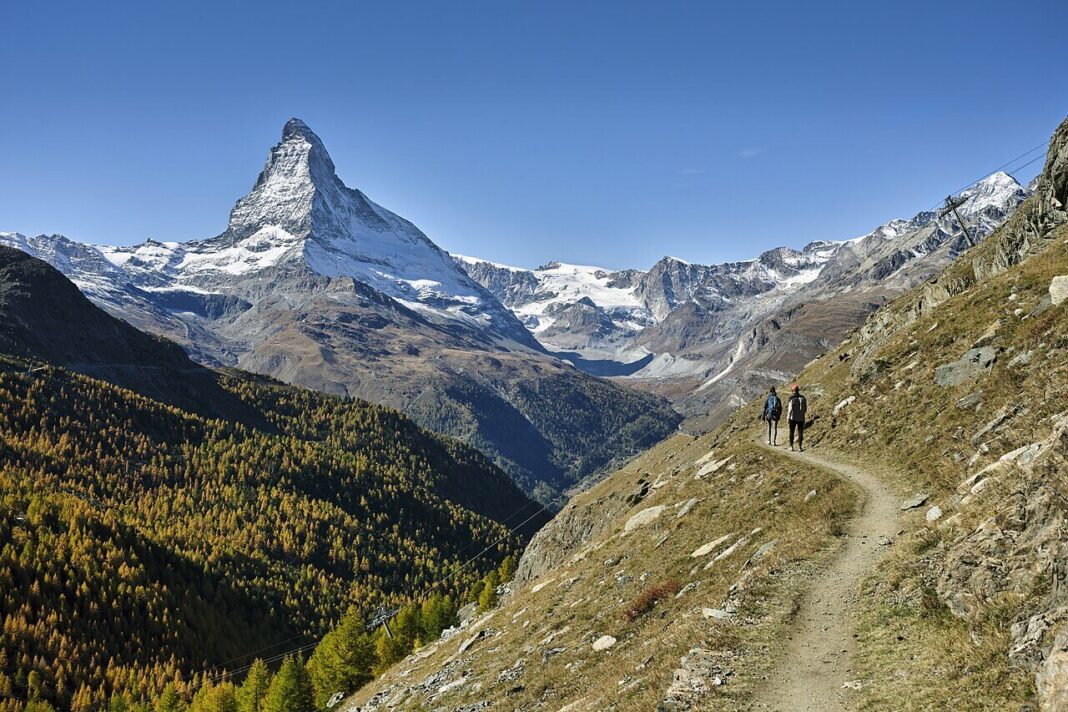
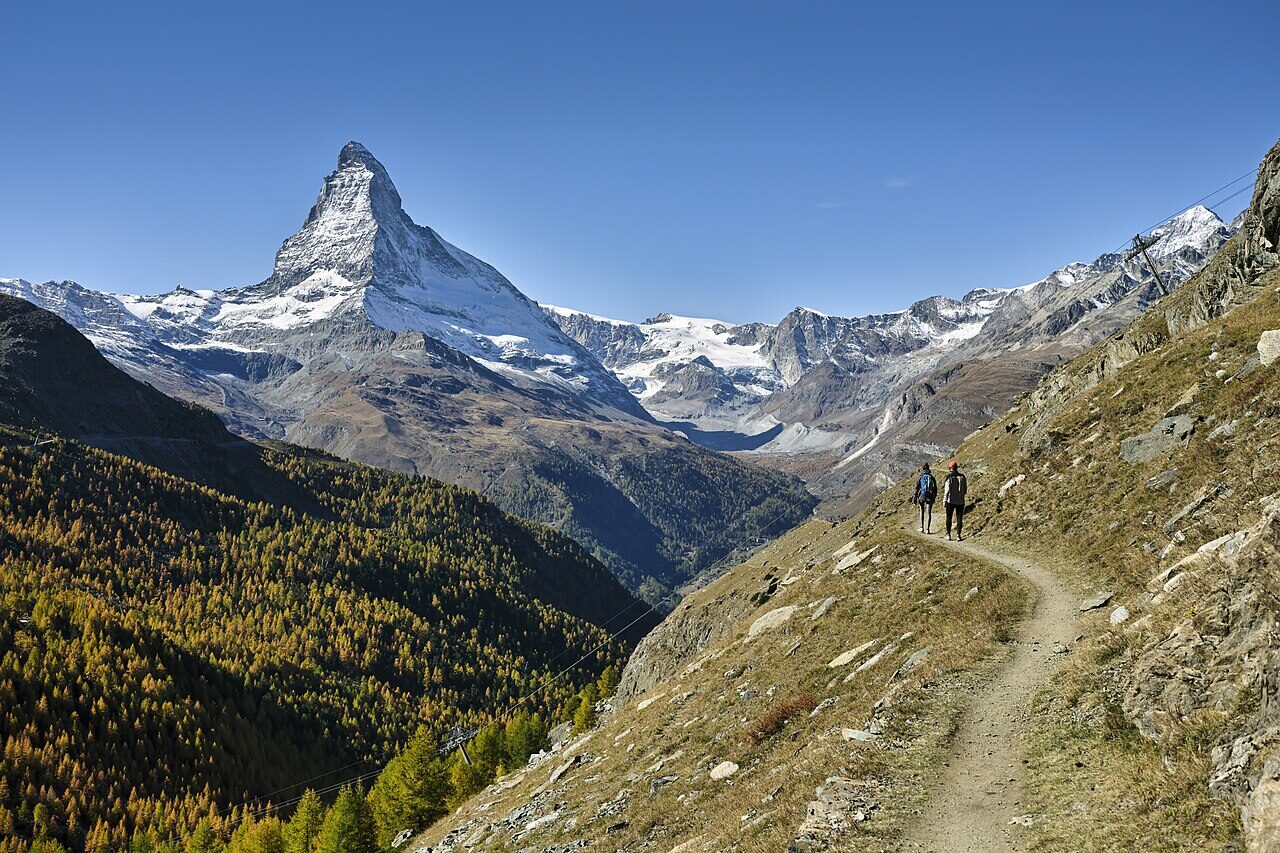
Photo: Hikers above Zermatt with the Matterhorn and autumn larches, by Roy Egloff, CC BY-SA 4.0 via Wikimedia Commons.