Some links on this page are affiliate links. If you book through them, we may earn a commission at no extra cost to you.
The Four Seasons Private Jet Experience is the most fully realised version of an idea several luxury operators have attempted: take a commercial airframe, strip it back to a fraction of its normal capacity, and fly a single group of guests around the world staying only at your own hotels. Four Seasons has been running it since 2015 and is now on its second aircraft, and the product has settled into something genuinely distinctive rather than a marketing exercise.
It is also extremely expensive, logistically rigid, and not remotely for everyone. Here is what it involves.
The Aircraft
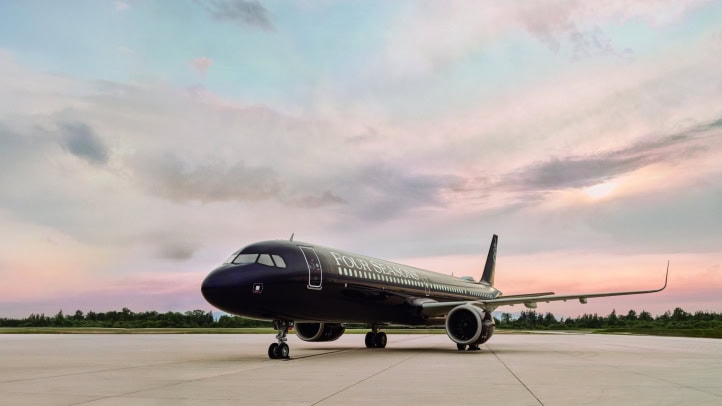
The current jet is a custom-configured Airbus A321neo-LR carrying just 48 guests. A standard A321neo in airline service seats around 200. That ratio is the entire proposition.
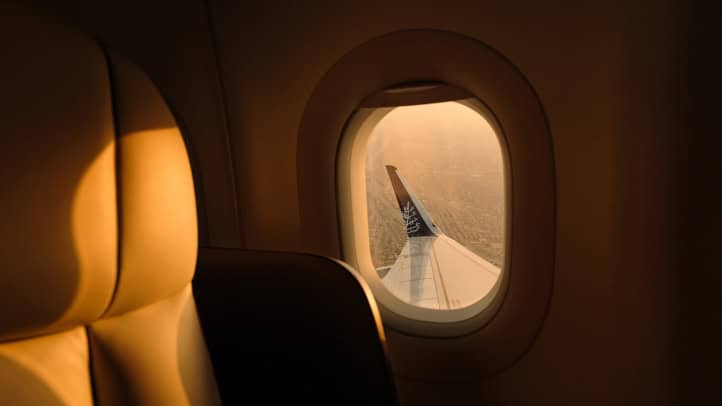
Every seat is a handcrafted leather flat-bed, arranged with generous personal space and no middle seats. The cabin was designed in-house rather than ordered from a catalogue, with a muted palette, custom textiles, and the Four Seasons tree motif worked into the interior detailing. There is a dedicated onboard lounge and bar area — a social space rather than a galley extension.
The aircraft also carries something most private jet programmes cannot offer: real range with real comfort. The LR designation means long range, which lets the jet operate the transoceanic legs these itineraries require without the fuel stops that plague smaller aircraft.
The Crew Is the Actual Product
The aircraft is impressive. The staffing is what separates this from chartering a jet yourself.
Every journey carries a dedicated Four Seasons team travelling with the group for the entire itinerary:
- Executive Chef — menus built around the destinations, cooked onboard, adjusted to guest preferences gathered before departure.
- Concierge — handles the things that normally consume a trip: reservations, requests, the small logistical failures that occur daily on a multi-country itinerary.
- Journey Physician — a full-time doctor travelling with the group. On a three-week itinerary crossing remote destinations, this is more valuable than it sounds.
- Experience Manager — runs the ground programme and the pacing.
Ground handling is where the time savings compound. Guests clear immigration as a group, often on the tarmac, with luggage handled door to door. You do not queue, you do not collect bags, and you do not see the inside of a terminal for most of the trip.

The Itineraries
Journeys fall into two broad shapes.
Around-the-world itineraries run roughly 21–26 days across eight to ten destinations, circumnavigating the globe. These are the flagship trips and they sell out earliest.
Regional itineraries run roughly 10–16 days and concentrate on a continent or theme — Asia, Africa, the Mediterranean, or a wellness-focused routing.
Recent and upcoming journeys give a sense of the range: African Wonders (Athens, the Pyramids, the Serengeti, Mauritius, Rwanda, Victoria Falls, Johannesburg), Asia Unveiled, Ancient Explorer, International Intrigue, and World of Wellness. Four Seasons has published itineraries into 2028, including a World Icons routing adding several first-time destinations.
Accommodation is at Four Seasons properties wherever one exists, and at a carefully chosen alternative where one does not — which is the honest constraint of the model, since Four Seasons does not have a hotel in the Serengeti or at Victoria Falls.
What It Costs
Pricing is published per person based on double occupancy, and it moves by itinerary.
| Itinerary type | Duration | Typical price per person |
|---|---|---|
| Regional journey | 10–16 days | ~$100,000–$150,000 |
| Around-the-world journey | 21–26 days | ~$180,000–$250,000+ |
| Single supplement | — | Typically 50–75% premium |
For a couple, an around-the-world journey lands between roughly $360,000 and $500,000. These are published-rate estimates and vary by departure, cabin allocation and itinerary; Four Seasons quotes each journey individually.
What’s included
Nearly everything: all flights on the jet, all accommodation, all meals onboard and most meals on the ground, all excursions and guided experiences, all ground transfers, all gratuities, all luggage handling, visa and document coordination, and the onboard medical support.
What’s not
Your flights to and from the start and end cities, travel insurance, spa treatments and incidental hotel charges, and any personal shopping. Budget for premium-cabin positioning flights on both ends — see our business class vs first class guide if those legs are long-haul.

Is It Worth It? The Honest Case Both Ways
The case for
Assembling the same trip independently — eight countries, private guides, top-tier hotels, first class flights between each — would cost a comparable amount and take months to plan. It would also involve eight sets of airport queues, eight hotel check-ins and a meaningful probability that at least one connection fails. The jet removes almost all of that friction, and for travellers whose scarcest resource is time rather than money, that is the whole argument.
The medical support and the group immigration handling are genuine, unglamorous advantages that matter most on exactly the itineraries people want to take.
The case against
You are on a fixed schedule with 47 other people. If you fall in love with a city, you leave anyway. If the group dynamic is poor, you are with it for three weeks. The pace of around-the-world itineraries is brisk — one to three nights per destination — which means breadth over depth. Anyone who prefers a week in one place will find it exhausting rather than luxurious.
And for the same money, you could charter a jet on your own schedule. Private jet charter gives you complete control of the itinerary, though you then own all the planning and ground logistics yourself. If you fly enough to be weighing structural options, our comparisons of NetJets vs Flexjet and membership vs charter cover the economics.
The Alternatives
| Operator | Aircraft / guests | Positioning |
|---|---|---|
| Four Seasons Private Jet | A321neo-LR, 48 guests | Hotel-brand consistency, onboard chef and physician, newest aircraft |
| TCS World Travel | Various, ~50–80 guests | The pioneer of the format; broader itinerary range, more academic expert-led programming |
| Abercrombie & Kent | Various, ~50 guests | Destination expertise and ground programming are the strength |
| Aman Jet Expeditions | Airbus ACJ TwoTwenty, 16–18 guests | Far smaller group; the most exclusive and the most expensive per head |
If group size is your primary concern, Aman’s expeditions carry roughly a third of the passengers. If destination depth matters more than brand consistency, TCS and A&K have longer track records on the ground.
How to Book
Journeys open roughly 18–24 months ahead and the flagship around-the-world itineraries frequently sell out within weeks of release, often to repeat guests before general availability. A deposit is required at booking with the balance due several months before departure.
Booking through a Four Seasons Preferred Partner or a well-connected luxury advisor costs nothing extra and can help with cabin placement and waitlist priority — the same logic we describe in our guide to whether you need a luxury travel advisor.
Frequently Asked Questions
How many people are on the Four Seasons Private Jet?
A maximum of 48 guests, aboard a custom Airbus A321neo-LR configured with handcrafted leather flat-bed seats.
How much does the Four Seasons Private Jet cost?
Roughly $100,000–$150,000 per person for regional journeys of 10–16 days, and about $180,000–$250,000 per person for around-the-world itineraries of three weeks or more, based on double occupancy. Prices vary by departure.
What is included in the price?
All jet flights, accommodation, most meals, excursions, ground transfers, gratuities, luggage handling and onboard medical support. Flights to and from the start and end cities are not included.
Do you stay only at Four Seasons hotels?
Wherever a Four Seasons property exists. On destinations without one — the Serengeti and Victoria Falls, for example — the itinerary uses a selected alternative.
Is there a doctor on board?
Yes. A Journey Physician travels with the group for the full itinerary, alongside an Executive Chef, Concierge and Experience Manager.
How far in advance should you book?
Itineraries are published 18–24 months out and the around-the-world journeys often sell out within weeks. Book as early as possible, and join the waitlist if a departure is already full.
Can you book a single seat?
Yes, though pricing is quoted per person on double occupancy and solo travellers pay a single supplement, typically 50–75%.
The Bottom Line
The Four Seasons Private Jet Experience is not a flight — it is a fully staffed, fully catered, fully handled expedition that happens to use a jet to move between stops. The aircraft is the newest in the category and the onboard team is the most complete. What you are buying is the removal of friction across a trip that would be genuinely difficult to assemble alone.
What you give up is control. Fixed dates, fixed pace, fixed company, and one to three nights per destination. If that trade appeals — and if the six-figure per-person price is not the deciding factor — it is the most polished product of its kind currently flying. If you would rather set your own schedule, charter the aircraft and keep the change.
Itineraries, pricing and aircraft configuration are set by Four Seasons and change between seasons. Confirm current details directly with Four Seasons or your advisor before booking. All jet imagery courtesy of Four Seasons Hotels and Resorts press room.