
Updated 2 November 2026.
The standard advice on the best time to visit Iceland for the Northern Lights is to go in December or January, because those are the darkest months. It sounds obvious. It is also, on thirty years of geomagnetic data, close to the worst advice you could follow.
December is the least geomagnetically active month of the year. Only 1.06% of three-hour intervals reach storm level, against 4.06% in October and 4.01% in September. January is second-worst at 1.49%. Darkness is only half the equation, and the other half runs in the opposite direction.
Combine the two — hours of true darkness multiplied by the probability of a geomagnetic storm — and October and November come out on top, with December second-to-last among viable months. That is the central finding of this guide, and we will show the work.
The short answer
- Northern Lights: late September through November, or March. Not December.
- Midnight sun and the highlands: late June through early August, with the deep interior not reliably open until the first week of July.
- Best value: January, when national hotel occupancy bottoms at 43.0% — but note February behaves like a shoulder month, not a trough.
- Best compromise: late September. You get real darkness, peak storm probability, 13 hours of daylight for driving, and the roads are still open.
The aurora calendar, properly calculated
Two facts drive everything. First, aurora happens year-round; it is simply invisible when the sky is not dark. Reykjavík has no nautical darkness at all from 28 April to 16 August — 111 consecutive nights — which is the physical reason the season runs roughly late August to mid-April.
Second, geomagnetic activity is strongly seasonal, peaking around the equinoxes. This is the Russell–McPherron effect, and NOAA states it outright: “the best seasons for aurora watching are around the spring and fall equinoxes.” Thirty years of Kp/ap data from GFZ Potsdam quantify it:
| Month | Mean ap | Intervals at storm level (Kp ≥ 5) |
|---|---|---|
| September | 11.72 | 4.01% |
| October | 11.85 | 4.06% |
| November | 10.70 | 3.26% |
| March | 11.05 | 3.09% |
| February | 9.45 | 1.72% |
| January | 8.73 | 1.49% |
| December | 8.11 | 1.06% |
Weighting each month by its hours of nautical darkness and its storm probability produces this ranking:
| Rank | Month | Dark hours (mid-month) | Storm probability | Relative index |
|---|---|---|---|---|
| 1 | November | 13.4 | 3.26% | 100% |
| 2 | October | 10.6 | 4.06% | 99% |
| 3 | September | 7.2 | 4.01% | 66% |
| 4 | March | 8.9 | 3.09% | 63% |
| 5 | January | 14.2 | 1.49% | 49% |
| 6 | February | 11.9 | 1.72% | 47% |
| 7 | December | 14.9 | 1.06% | 36% |
December has the most darkness of any month and still finishes last, because there is three to four times less to see. October and November beat it by nearly 3×.
You do not need Kp 5
The second myth worth killing: the advice to wait for a Kp index of 5 or higher. Iceland sits under the auroral oval at baseline. NOAA notes that at Kp 0 the equatorward edge of the oval already sits around 66° magnetic latitude, and that “very nice auroral displays” occur at Kp 3–4 for a well-positioned observer. The Icelandic Met Office adds that Kp is 0–4 about 90% of the time. Telling people to wait for Kp 5 tells them to write off nine nights in ten.
Where we are in the solar cycle, honestly
Solar Cycle 25 peaked in October 2024 at a smoothed sunspot number of 160.9. It has fallen steadily since — the monthly number was 45.7 in October 2026. So no, 2027 is not “solar maximum,” and content still claiming so is two years stale.
But the correction has a correction. Geomagnetic activity — which is what actually produces aurora — lags sunspot maximum by one to three years. The annual mean ap index for 2025 was 15.45, the highest since 2003. In Cycle 23, sunspots peaked in 2000 but geomagnetic activity peaked in 2003. The honest framing for 2027: we are in the declining phase, which historically still delivers excellent aurora, and conditions remain materially better than any year between 2017 and 2022.
Daylight: the number that actually shapes your itinerary
Iceland’s defining variable is not temperature. It is light.
| Date | Sunrise | Sunset | Daylight |
|---|---|---|---|
| 1 January | 11:20 | 15:42 | 4h 22m |
| 15 February | 09:25 | 17:59 | 8h 33m |
| 20 March (equinox) | 07:31 | 19:40 | 12h 10m |
| 15 May | 04:14 | 22:34 | 18h 19m |
| 21 June (solstice) | 02:55 | 00:04 | 21h 09m |
| 15 September | 06:49 | 19:57 | 13h 08m |
| 15 October | 08:16 | 18:11 | 9h 55m |
| 21 December (solstice) | 11:22 | 15:29 | 4h 07m |
The swing between longest and shortest day is 17 hours and 2 minutes. In March and September the country gains or loses about three minutes a day — twenty minutes a week.
And a correction worth making, because it appears constantly: Reykjavík does not get the midnight sun. At 64.15°N it sits below the Arctic Circle and the sun does set. What it gets is better copy anyway: from 20 May to 24 July the sun never drops more than 6° below the horizon, so it never gets genuinely dark — 66 consecutive white nights. For true midnight sun you need to go north to Grímsey.
Weather: it is not cold, and it is never dry
Two durable misconceptions, both easy to settle with numbers.
Iceland is not freezing. Reykjavík’s January mean is 33.2°F. New York’s Central Park, on the same 1991–2020 basis, is 33.6°F. Chicago O’Hare is 24.3°F. Reykjavík in January is marginally milder than New York and nearly nine degrees milder than Chicago. The real winter problem is wind, rain and four hours of daylight — not cold.
There is no dry season. Reykjavík records measurable precipitation on 16 to 20 days in every single month of the year. May is the driest by day count at 16.6; December the wettest at 20.1. Volume varies roughly two-fold across the year; frequency barely varies at all.
| Month | Reykjavík high / low | Precip | Sunshine hrs | Akureyri high / low | Akureyri precip |
|---|---|---|---|---|---|
| January | 37.7° / 28.9°F | 3.43″ | 22.6 | 36.8° / 25.7°F | 2.37″ |
| March | 39.5° / 29.7°F | 3.18″ | 110.3 | 38.3° / 27.3°F | 1.87″ |
| May | 50.1° / 39.1°F | 2.07″ | 209.0 | 50.6° / 37.7°F | 0.95″ |
| June | 55.4° / 45.0°F | 1.71″ | 189.5 | 56.7° / 43.8°F | 0.82″ |
| July | 58.8° / 48.4°F | 1.97″ | 183.1 | 59.2° / 47.3°F | 1.33″ |
| September | 52.6° / 43.2°F | 3.42″ | 118.3 | 53.3° / 41.7°F | 2.09″ |
| November | 40.4° / 31.9°F | 3.40″ | 39.7 | 38.6° / 28.2°F | 2.69″ |
| December | 38.0° / 29.1°F | 3.74″ | 12.6 | 36.6° / 25.5°F | 2.86″ |
Note the north. Akureyri is 35% drier than Reykjavík annually — 574 mm against 876 mm — and it averages under an inch of rain a month from April to June, with warmer July days despite being 200 miles further north. The north is genuinely the dry side. But “drier” is not “brighter”: Akureyri records 0.3 hours of sunshine in December and 6.5 in January, against Reykjavík’s 12.6 and 22.6.
The highlands do not open on a date
The F-roads are the most common trip-planning failure. They do not open on a fixed calendar date — the Icelandic Road Administration states that snow cover is the governing factor, and the spread between routes is five weeks.
| Route | Earliest (2021–25) | Latest | Five-year average |
|---|---|---|---|
| Route 35 Kjölur (Gullfoss–Hveravellir) | 30 May | 14 June | 1 June |
| F208 Sigalda–Landmannalaugar | 23 May | 23 June | 2 June |
| F225 Landmannaleið | 9 June | 24 June | 16 June |
| F206 Lakagígar | 12 June | 1 July | 20 June |
| F261 Emstruleið | 23 June | 15 July | 5 July |
| F26 Sprengisandur | 21 June | 13 July | 6 July |
| F210 Keldur–Hvanngil | 23 June | 15 July | 7 July |
Kjölur and the Landmannalaugar approach average around 1–2 June. Sprengisandur and the F210 do not average open until the first week of July. A reader booking a Landmannalaugar-dependent trip for early June has a real chance of arriving before the road opens. F-roads typically close again from mid-September.
One safety note the official source states bluntly and we will repeat: no insurance covers damage to a vehicle while crossing a river. Live status is at umferdin.is or the road authority’s 24-hour line, 1777.
Crowds, rates and the current soft patch
Iceland received 2,267,638 foreign visitors in 2025, and the trend is flat to declining — up just 0.3% on 2024, with 2026 running 0.7% behind. The United States is the largest source market at 661,929 visitors, 29.2% of the total.
But American travellers are far more seasonally concentrated than the average visitor — a peak-to-trough ratio of 3.75× against 2.61× overall. In plain terms: the typical American is going in exactly the most crowded, most expensive window.
| Month | National hotel occupancy | Capital region | Year-on-year |
|---|---|---|---|
| August 2026 | 88.7% | 89.0% | −1.2% |
| July 2026 | 87.9% | 87.2% | +0.1% |
| September 2025 | 81.6% | 84.4% | +3.6% |
| February 2026 | 64.2% | 76.8% | +2.2% |
| December 2025 | 45.3% | 57.7% | −12.7% |
| January 2026 | 43.0% | 56.2% | −8.3% |
Three things to take from that. The national swing is 45.7 percentage points, but the Reykjavík swing is far gentler — so the discount is much deeper outside the capital. February is not a trough; at 64.2% nationally it was the only month in the last twelve to grow year-on-year. And winter 2025/26 softened sharply, with December down 12.7%, which means negotiating leverage on winter rates is real right now. For where to spend it, see our guide to the best luxury hotels in Iceland.
Volcanoes, and what the Met Office actually says
Iceland’s tourist board page on the subject is still headlined “volcanic activity has ended on the Reykjanes Peninsula,” dated August 2025. The Icelandic Met Office’s assessment of 27 October 2026 says something different: the Svartsengi system remains at alert level 2 (orange), roughly 29.1 million m³ of magma has accumulated since July 2025, a new intrusion toward the Sundhnúkur crater row and possible eruption is “the most likely scenario,” and there is no sign the episode is ending.
The travel-relevant nuance matters just as much, though: there has been no eruption for more than a year, airports have operated normally throughout, no Reykjanes eruption has disrupted international air travel, and the Blue Lagoon has reopened after each precautionary evacuation. Warning times before past events have ranged from about 20 minutes to four hours. It is a reason to check status at booking, not a reason to cancel.
Wildlife and 2027 practicalities
- Puffins are present roughly April to mid-September. The common claim that they leave in mid-August reflects when tours stop, not when the birds go — the 2025 puffling rescue season in the Westman Islands ran to 29 September. Worth knowing: the Atlantic puffin is now Critically Endangered on Iceland’s national Red List, having been Least Concern in 2000.
- Whales have two peaks that are not the summer window most people assume: blue and fin whales off the north coast from mid-June to mid-July, and orcas off Snæfellsnes from February to May.
- PLAY ceased operations on 29 September 2025. The budget transatlantic option to Iceland no longer exists; any guide still listing it is over a year out of date. Icelandair adds Reykjavík–St. Louis from 14 May 2027.
- Lodging tax is ISK 800 per unit per night for hotels. Iceland’s 2027 Budget proposes removing the reduced 11% VAT rate on lagoon and spa admission, moving it to the standard 24% — not yet enacted, but the most financially relevant pending item for a luxury Iceland trip.
Frequently asked questions
What is the single best month for the Northern Lights in Iceland?
On darkness and geomagnetic data combined, November, with October statistically indistinguishable behind it. December, despite having the most darkness, ranks last among viable months because storm probability collapses to 1.06%.
Is December a bad time to visit Iceland?
For aurora specifically, it is the weakest of the viable months. For everything else — Christmas markets, short-day city breaks, lowest-of-the-year hotel rates in January — it has real merits. Just do not book December because of the lights.
How many nights should I stay to see the aurora?
Iceland’s own guidance for comparable latitudes is that three clear nights makes a sighting highly likely but never certain. Build in more nights than you think you need, and base outside Reykjavík if you can.
When do the F-roads and highlands open?
There is no fixed date. On a five-year average, Kjölur and the Landmannalaugar approach open around 1–2 June; Sprengisandur and the F210 not until roughly 6–7 July. Check umferdin.is before committing.
Is it safe to visit Iceland with the volcanic activity?
Travel has been essentially unaffected throughout — no Reykjanes eruption has disrupted international flights, and the activity is confined to a small, closely monitored area. Check the Met Office status at booking rather than assuming either that it is over or that it is dangerous.
Related reading
Sources: Icelandic Met Office station archives and aurora/volcano bulletins; NOAA Space Weather Prediction Center observed solar cycle indices; GFZ Potsdam Kp/ap series since 1932; NOAA GHCN-Daily; Icelandic Tourist Board visitor statistics; Statistics Iceland accommodation data via Ferðamálastofa; Icelandic Road and Coastal Administration; Skatturinn; BirdLife Iceland.
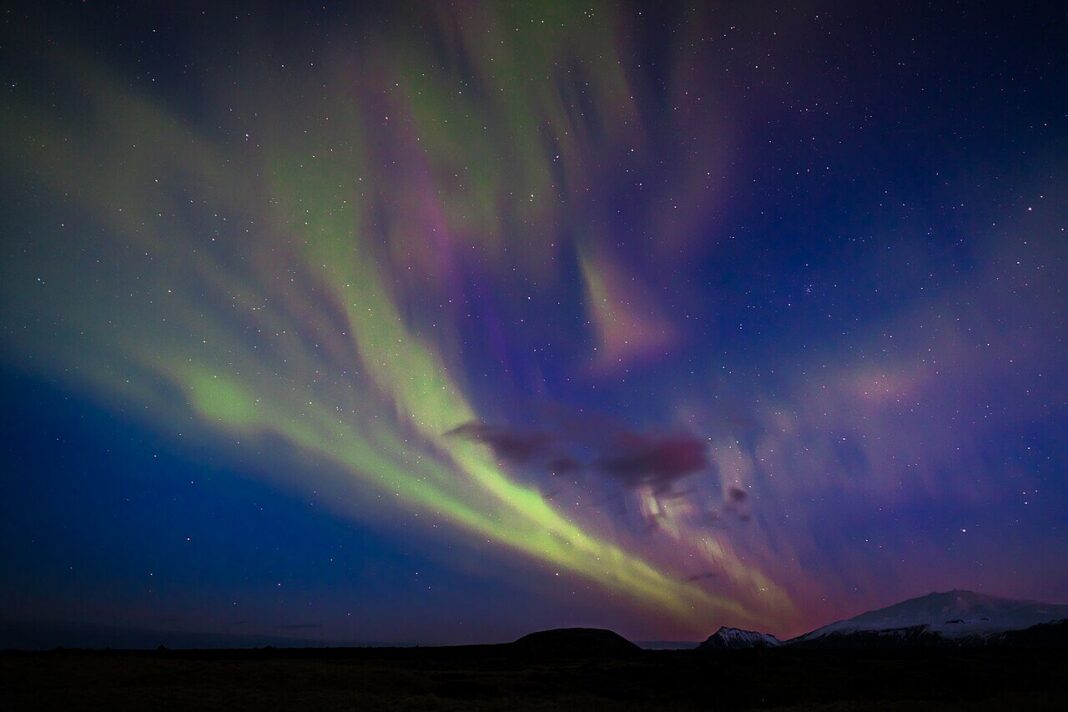
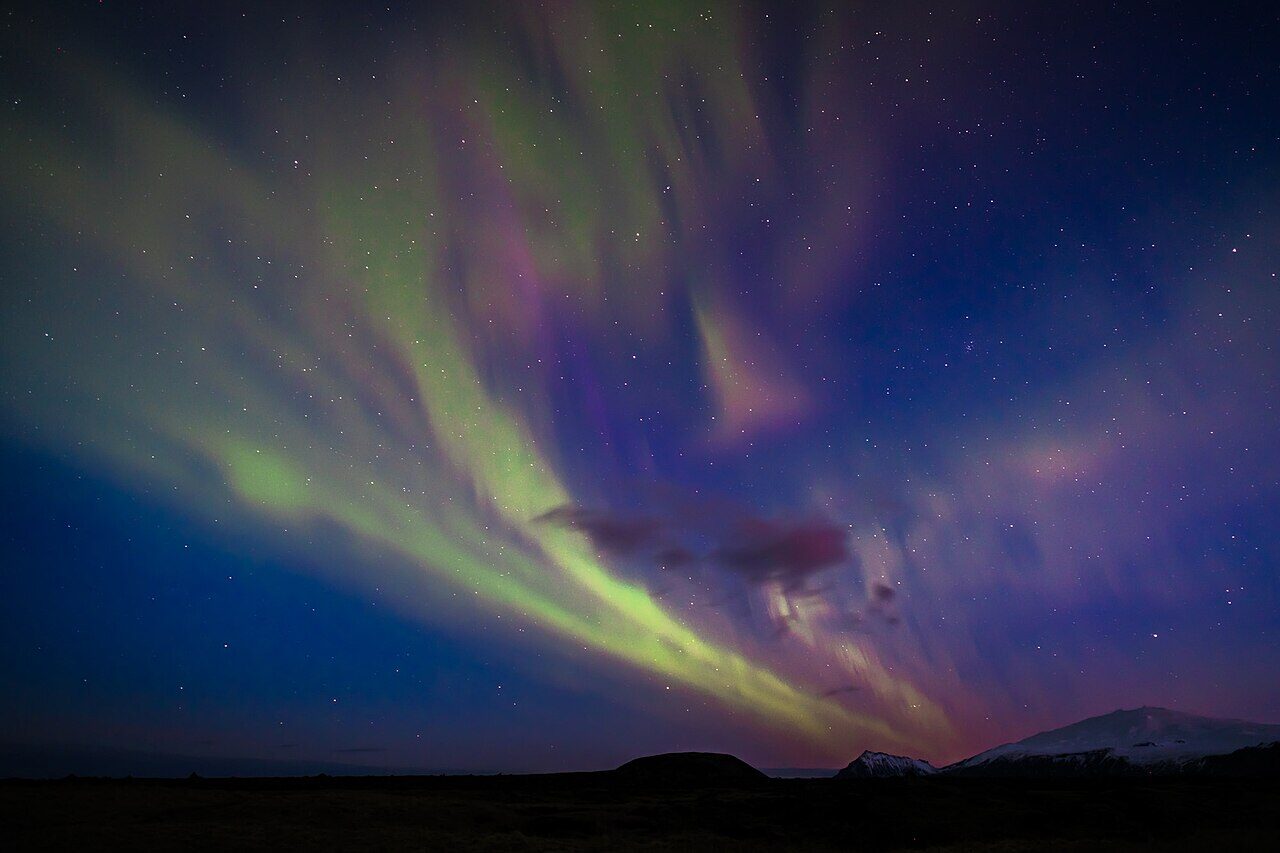
Photo: Aurora over Snæfellsnes, Iceland, by Giuseppe Milo, CC BY 3.0 via Wikimedia Commons.