
Search “Hawaii all-inclusive resorts” and you will find dozens of lists promising exactly that. Most of them are wrong, and several name properties that stopped offering all-inclusive rates years ago.
Here is the position, stated plainly by a company that actually sells Hawaii holidays for a living. Pleasant Holidays — a major Hawaii tour operator, not a blog — says on its own site that “currently there are no completely ‘all-inclusive’ hotel packages offered in Hawaii.” Their explanation is structural rather than commercial: the open nature of Hawaiian resorts and their close proximity to one another. There are no gated compounds and no wristbands. Guests wander freely between neighbouring hotels’ restaurants, and every beach in Hawaii is public by law. The all-inclusive model, which depends on keeping you inside the fence, has nothing to hold onto.
That said, there is one genuine exception, and there are several packages that get you most of the way there. This guide covers what actually exists in 2027, what it costs, and the one tax change that has quietly raised the price of every Hawaii hotel night since January 2026.
The short answer
| Property | Island | All-inclusive? | What’s actually included |
|---|---|---|---|
| Sensei Lānaʻi, A Four Seasons Resort | Lānaʻi | Closest thing in Hawaii | Opt-in dining plan $375/guest/day; wellness credit; flights from Honolulu |
| The Kahala Hotel & Resort | Oʻahu | No — but best package | Signature Experience: breakfast, airport transfer, massage for two. No resort fees. |
| Four Seasons Resort Lānaʻi | Lānaʻi | No | Bed & Breakfast rate; round-trip flights included through 31 Dec 2027 |
| Hana-Maui Resort | Maui | No — it used to be | Nothing inclusive. $45/night resort fee, $20 parking |
| Kona Village, A Rosewood Resort | Big Island | No | $95/night resort fee — the highest found. Explicitly excludes meals |
| Timbers Kauai | Kauaʻi | No | $100 daily resort credit, two cocktails |
| Norwegian’s Pride of America | All four | Closest product | Four islands in seven days, main dining included |
Sensei Lānaʻi: the only real all-inclusive option in Hawaii
If you want to prepay for your food in Hawaii, there is exactly one serious way to do it.
Sensei Lānaʻi, A Four Seasons Resort, sells a “Discover Sensei” package at $450 per person per night as a spa-and-wellness credit, covering spa treatments, salon, wellbeing consultations and island excursions. It includes daily rotating wellbeing classes, access to the grounds, spa hale and sculpture garden, semi-private round-trip air transfers from Honolulu, and transport over to Four Seasons Resort Lānaʻi for the beach and its restaurants. There is a two-night minimum, and the resort is adults-only from age 16. Published rates start from $1,340 per night single and $1,700 double, per room, before taxes, service charges and gratuities.
Crucially, meals are not included by default. All-inclusive dining at Sensei by Nobu is a separate add-on at $375 per guest per day, selected at check-out. That single line item is the closest thing to a true all-inclusive meal plan anywhere in the Hawaiian islands.
One thing worth a phone call before you commit: the resort’s published materials do not state whether that $375 daily dining plan covers alcohol. Ask.
Other tiers exist — “Guided Wellness” at a $150 per night credit with daily private sessions, a “Self-Guided Stay” that includes the semi-private air from Honolulu, structured five-day programmes and a month-plus “Sabbatical” — but prices for these are not published.
The myth that will not die: Hana-Maui Resort
This is the single most common error in Hawaii all-inclusive content, and it is worth being precise about.
Under its former name, Travaasa Hana, the property on Maui’s remote eastern shore genuinely did sell all-inclusive packages. That ended. The resort rebranded to Hana-Maui Resort, a Destination by Hyatt, in September 2020, after Mani Brothers Real Estate Group bought the 72-acre property for around $27 million.
Hyatt’s own FAQ confirms the current position: no all-inclusive rate, no meal plan, not even a breakfast-inclusive package. The property charges a $45 nightly resort fee and $20 per night for self-parking, with no valet.
The Travaasa brand no longer exists in Hawaii at all. Any article currently offering you “Travaasa Hana all-inclusive” is selling a property that has not existed under that name for six years. It remains a beautiful and genuinely remote hotel — it is simply not an all-inclusive one.
And no, Club Med has never operated in Hawaii, past or present. Its only former US village was Copper Mountain in Colorado, now closed.
Watch for “all-inclusive” marketing that isn’t
Lumeria Maui is the clearest live example. Its homepage carries an “All-Inclusive Specials” link. Follow it and the page behind describes no all-inclusive package at all — a $100 spa credit, a seven-night “Stay Your Way” package at 20% off that includes a yoga mat, grounds access, a curated tour list and WiFi but no meals, and a book-direct discount. The only rate there that bundles meals is the Kamaʻāina rate, which includes complimentary wellness classes and daily breakfast and is restricted to Hawaii residents with ID at check-in.
The label said all-inclusive. The product is not one. Check the terms page, never the banner.
What experienced Hawaii travellers book instead
Resort credits — the dominant Hawaii substitute
Rather than prepaying for everything, Hawaii resorts hand you a credit to spend on site. The difference matters: a credit usually expires daily and is rarely combinable.
- The Kahala (Oʻahu) — “Legacy of Aloha”: daily breakfast for two, a $150 dining credit and a $100 spa credit per stay. “Fall into Paradise”: 20% off plus a $200 resort credit. The Kahala Signature Experience is the only Hawaii package found that bundles meals, a round-trip airport transfer and an activity (a massage for two).
- Timbers Kauai at Hōkūala — “Island Escape”: 15% off, a $100 daily resort credit and two complimentary cocktails at Hualani’s.
- Four Seasons Resort Lānaʻi — an “Experience More” spending credit, plus a formal Bed and Breakfast rate, and round-trip luxury flights included on all bookings with arrivals by 31 December 2027. That last item is worth real money.
The no-resort-fee play
The Kahala advertises “No Resort Fees” on direct bookings. On a seven-night stay, against Kona Village’s $95 a night, that single difference is worth $665 before tax — more than most resort credits.
The inter-island cruise
Pleasant Holidays itself calls a Hawaii cruise “the closest thing” to an all-inclusive resort here, and the obvious candidate is Norwegian’s Pride of America, which sails year-round round-trip from Honolulu and visits four islands in seven days with two overnights and no sea days.
For a sample sailing departing 31 October 2026, published fares per person at double occupancy were inside $1,527, balcony $2,576 and suite $2,886. Single occupancy generally costs 100% more.
One correction worth having. You will see aggregator listings claiming the cruise price includes everything with “no sneaky extra fees.” That is not accurate. NCL includes its main dining rooms, diner, cafés, grills and buffet, but roughly twenty named specialty venues — Cagney’s, Le Bistro, Los Lobos, Teppanyaki — cost extra, and NCL levies a separate mandatory daily service charge on top. NCL does not describe its own dining as all-inclusive. Confirm the current service-charge amount at booking.
Flight-plus-hotel packages
Costco Travel and Pleasant Holidays both bundle air, hotel and car. Neither describes any Hawaii package as all-inclusive — Pleasant Holidays states its packages “generally exclude meals, activities, and drinks,” and reserves the term for the Caribbean and Mexico. These are bundles, and useful ones, but they are not the same product as a Caribbean all-inclusive.
What Hawaii actually costs in 2027: taxes, fees and the “green fee”
This is where most guides are either vague or wrong, and where a careful reader saves real money.
The lodging tax went up on 1 January 2026
Hawaii’s transient accommodations tax rose from 10.25% to 11% effective 1 January 2026, under Act 96 of 2025. The policy nickname for this is the “green fee,” which causes a persistent misunderstanding: Act 96 did not add a separate green-fee line to your hotel bill. It raised the existing TAT by 0.75 percentage points. If you are looking for a distinct charge labelled “green fee,” you will not find one.
Act 96 also newly extends the tax to cruise ship operators. The cruise industry sued over that provision; the court dismissed the vast majority of the claims and denied an injunction, allowing the measure to take full effect on 1 January 2026, though the litigation is not finished.
The combined rate: 18.5%, but your bill will say about 18.7%
The statutory arithmetic is 4.5% general excise tax + 11% state TAT + 3% county TAT = 18.5%, and the county TAT is 3% in all four counties.
But the figure on your folio will usually be slightly higher, and there is a precise reason. Hawaii’s general excise tax is levied on gross receipts, and gross receipts include any tax passed on to the customer. To recover the full 4.5%, a hotel has to restate it as a percentage of the price: 4.5% ÷ 95.5% = 4.712%. The state tax department publishes this explicitly. So the effective combined rate commonly billed is about 18.712%.
Note also that both taxes apply to resort fees, not just the room rate.
Resort fees and parking at Hawaii luxury resorts
| Resort | Daily resort fee | Parking |
|---|---|---|
| Kona Village, A Rosewood Resort | $95 + tax (new bookings from 21 Nov 2025) | Not stated |
| Fairmont Kea Lani, Maui | $59 + tax | Valet $59/night; self-parking included in resort fee |
| Grand Wailea, Maui | $55 per room | Not published |
| Hana-Maui Resort | $45 | Self-park $20/night, no valet |
| The Royal Hawaiian, Waikīkī | Not published | Self-park $55/day, valet $65/day + tax |
| The Kahala, Oʻahu | None advertised on direct bookings | Not stated |
Kona Village’s $95 covers non-motorised water equipment, spa access, the fitness centre, tennis and pickleball and bicycles — and explicitly not meals. Worth knowing before you assume a high resort fee is a quasi-meal-plan.
When to go — and the shoulder-season discount nobody quantifies
State hotel performance data gives a much better answer than the usual “spring and autumn are cheaper.”
Looking at luxury-class average daily rate statewide in 2026: January ran $749.62, August $740.28, and May — a shoulder month — $645.08. That is roughly 14% below January and 13% below August, or about $95–$105 a night saved on a luxury room purely on timing.
The statewide gap across all hotel classes was only about 10%, which tells you something useful: the luxury tier discounts shoulder season more aggressively than the market as a whole.
By island, the January / May / August pattern:
- Maui County $545.68 / $493.86 / $525.74 — consistently the most expensive, but see below.
- Island of Hawaiʻi $496.54 / $427.24 / $471.02 — the biggest shoulder swing at about 14%, so the best island for timing arbitrage.
- Kauaʻi $430.78 / $409.40 / $430.63 — the flattest. Timing buys you least here.
- Oʻahu $287.11 / $264.37 / $294.58 — cheapest throughout.
Maui in 2027: where things actually stand
Maui remains the island travellers ask about most cautiously, so here is the current position from the county rather than from travel blogs.
Front Street in Lahaina reopened to vehicle traffic on 1 August 2026, on the stretch from Pāpalaua to Shaw, with no regularly restricted hours. Dickenson and Prison streets also reopened. Market Street, Papelekane Street and Mokuhinia Place remain closed, partly because of the state’s dredging of Lahaina Harbor. Commercial activity has returned with the ʻUlu o Lele Marketplace, Kimo’s restaurant and more than a dozen other businesses.
All of Kāʻanapali, Napili, Kahana and Kapalua are open, including beaches and activities, along with more than sixty West Maui restaurants. Expect construction, limited parking and slow traffic in places.
Hawaii’s official tourism site now carries no closure, safety or recovery notice for Lahaina or West Maui at all — the posture is that Maui is open and visitors are welcome.
One trap to be aware of: several listicles still repeat a list of Maui closures — Road to Hāna inaccessible, Haleakalā closed, ʻĪao Valley closed — that came from a severe rain and flash-flooding event in March 2026, not from wildfire recovery. Those were temporary weather closures, and repeating them as current status is simply wrong.
There is a value angle in the numbers. Maui County hotel occupancy ran 62.4% in August 2026 against Oʻahu’s 79.2%. Within Maui, Wailea RevPAR was up 10.0% year on year while Lahaina/Kāʻanapali/Kapalua managed 2.8% with occupancy slightly down. West Maui is still softer than South Maui — which, for a traveller, means negotiating room.
Which island for which traveller
- Oʻahu — the cheapest island throughout and the one where the absence of all-inclusives matters least, because you are surrounded by restaurants you would want to eat at anyway. Best air access. Home to the Kahala and its no-resort-fee policy.
- Maui — the most expensive island but the softest occupancy, which is the best negotiating position in Hawaii right now. See our guide to Maui’s five-star hotels.
- Kauaʻi — the Garden Isle, dramatic scenery, the flattest seasonality in the state. Timbers Kauai carries the best resort credit on the island.
- Island of Hawaiʻi — volcanoes, coffee, stargazing, and the largest shoulder-season discount. Home to Kona Village and its $95 resort fee.
- Lānaʻi — tiny, two Four Seasons properties, reached by semi-private air from Honolulu that is included in both Sensei and Four Seasons Lānaʻi bookings. This is where Hawaii’s only genuine all-inclusive-style product lives.
- Molokaʻi — no luxury resort inventory. A deliberate choice for travellers who want the undeveloped version of Hawaii, and out of scope for this guide.
Frequently asked questions
Are there any true all-inclusive resorts in Hawaii?
Essentially no. Pleasant Holidays, a major Hawaii tour operator, states on its own site that no completely all-inclusive hotel packages are offered in Hawaii. The nearest thing is Sensei Lānaʻi, which sells an opt-in all-inclusive dining plan at $375 per guest per day on top of its nightly rate.
Why doesn’t Hawaii have all-inclusive resorts like Mexico or the Caribbean?
Structural reasons rather than commercial ones. Hawaiian resorts are open rather than gated, they sit close together, every beach is public by law, and guests move freely between neighbouring hotels’ restaurants. The all-inclusive model depends on containment that Hawaii’s geography and law do not permit.
Is Hana-Maui Resort still all-inclusive?
No. As Travaasa Hana it did offer all-inclusive packages, but that ended when the property rebranded to Hana-Maui Resort, a Destination by Hyatt, in September 2020. Hyatt’s own FAQ confirms there is no all-inclusive rate, no meal plan and no breakfast package. It charges a $45 nightly resort fee and $20 for parking.
What is Hawaii’s green fee and will I see it on my bill?
Not as a separate line. Act 96 of 2025 — nicknamed the green fee — raised Hawaii’s transient accommodations tax from 10.25% to 11% effective 1 January 2026. It is folded into the tax rate, not charged separately.
What is the total tax on a Hawaii hotel room?
Statutorily 18.5% — 4.5% general excise tax plus 11% state TAT plus 3% county TAT. In practice most bills show around 18.7%, because hotels gross up the general excise tax to 4.712% to recover it fully. Both taxes also apply to resort fees.
When is the cheapest time to visit Hawaii?
On verified state data, May. Luxury-class average daily rate statewide ran $645 in May 2026 against $750 in January and $740 in August — roughly $95–$105 a night less. The autumn shoulder is widely claimed to be cheaper still, but state figures were not available past August at the time of writing.
Is Maui open to visitors?
Yes. Front Street in Lahaina reopened to traffic on 1 August 2026, Kāʻanapali through Kapalua are fully open, and Hawaii’s official tourism site carries no visitor restriction notice for West Maui. A few Lahaina side streets remain closed during harbour dredging.
Rates, fees and tax rates were verified against resort, state and county sources in October 2026. Resort fees and packages change without notice — confirm directly before booking. Where a property does not publish a figure, this guide says so rather than estimating.
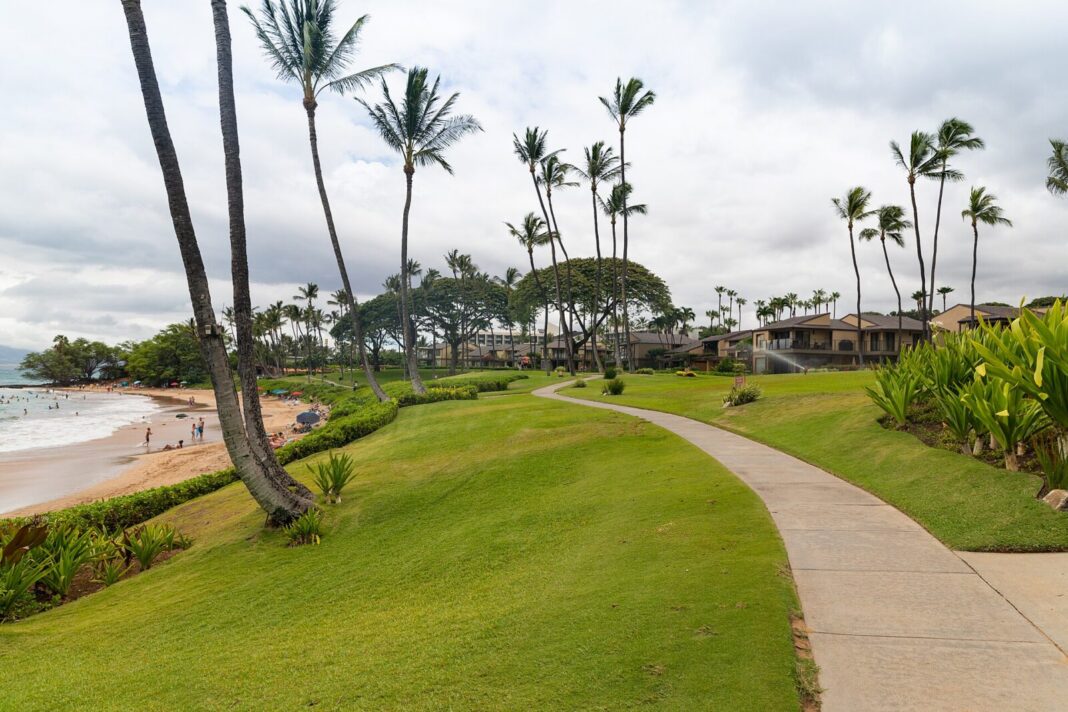
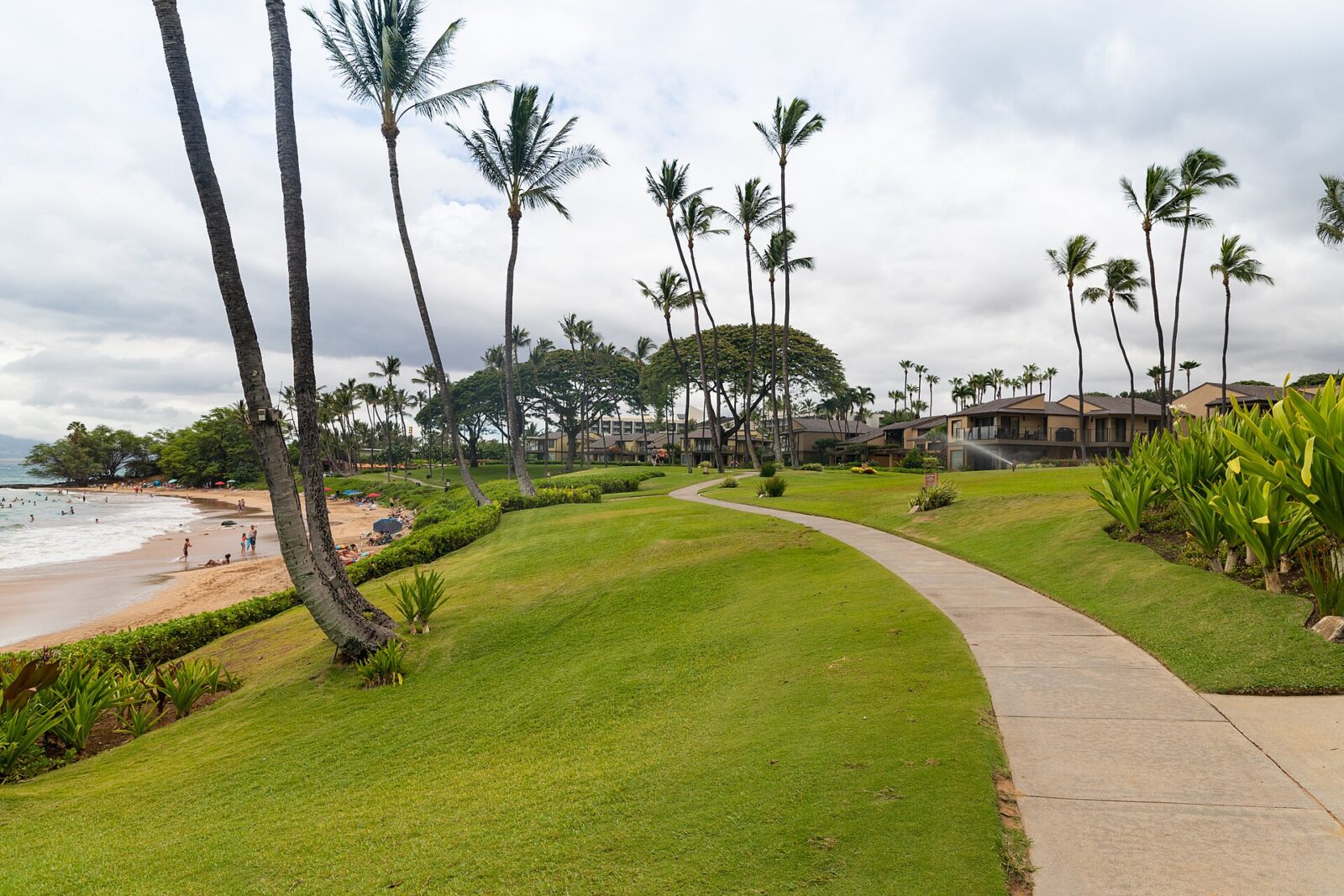
Image: the Wailea beach path, Maui, by dronepicr, licensed CC BY 2.0 via Wikimedia Commons.
More from LUXGetaway: The Best Luxury All-Inclusive Resorts in the World · Four Seasons Maui at Wailea · Fairmont Kea Lani, Maui