
If you have searched for American Airlines first class, you have almost certainly been shown four different products under three different names, and nobody has told you which one you are actually buying. That confusion is about to get simpler in the worst possible way: American is in the middle of deleting first class from its airline altogether.
The dates are specific and they are now. American stopped selling Flagship First on the Boeing 777-300ER for travel beginning 19 November 2026. It stops selling Flagship First on its transcontinental A321 for travel beginning 28 March 2027. After that second date, American Airlines will have no cabin above business class on any widebody or transcontinental aircraft. What remains will be domestic First on narrowbody jets, which is a wide recliner, not a suite.
This guide explains what is still flying, what is replacing it, and which of the five names on American’s own website actually matters when you are choosing a seat.
American Airlines has five premium cabin names in live use
This is not an exaggeration. Read American’s own aircraft pages and its Flagship dining page together and you will count five distinct names:
- First — the domestic recliner on narrowbody and regional jets.
- Flagship First — the genuine international and transcontinental first class, now being withdrawn.
- Flagship Business — the long-haul business cabin on most widebodies.
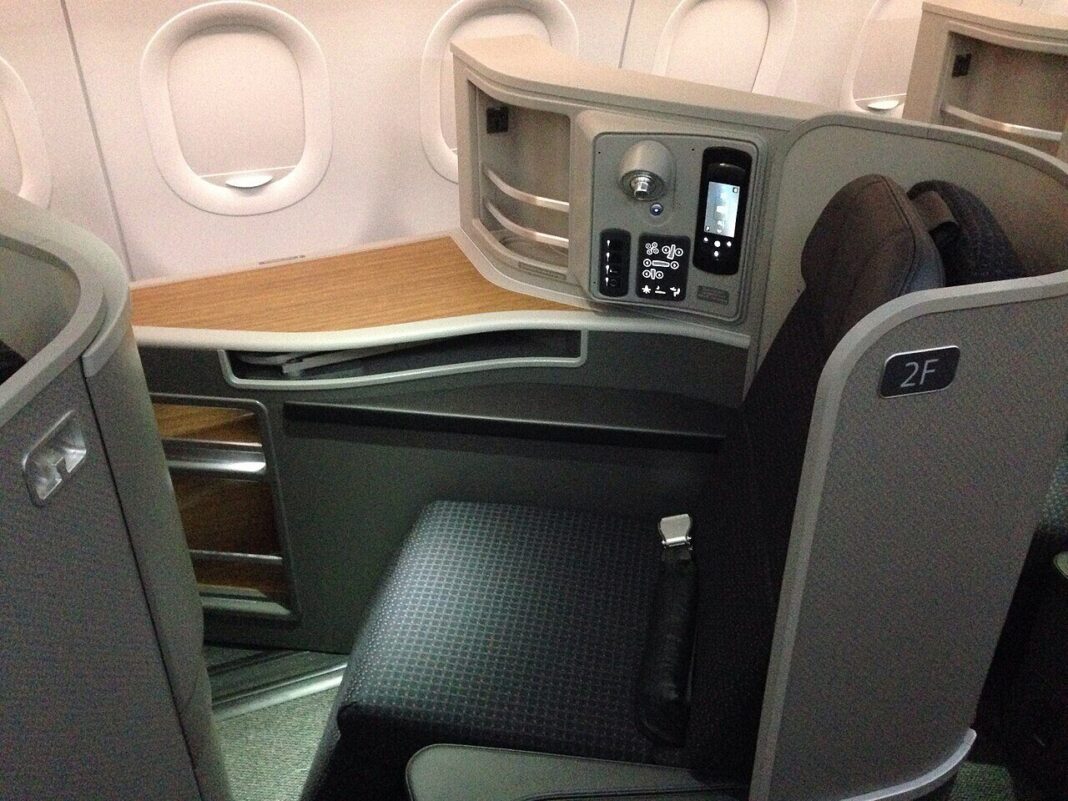
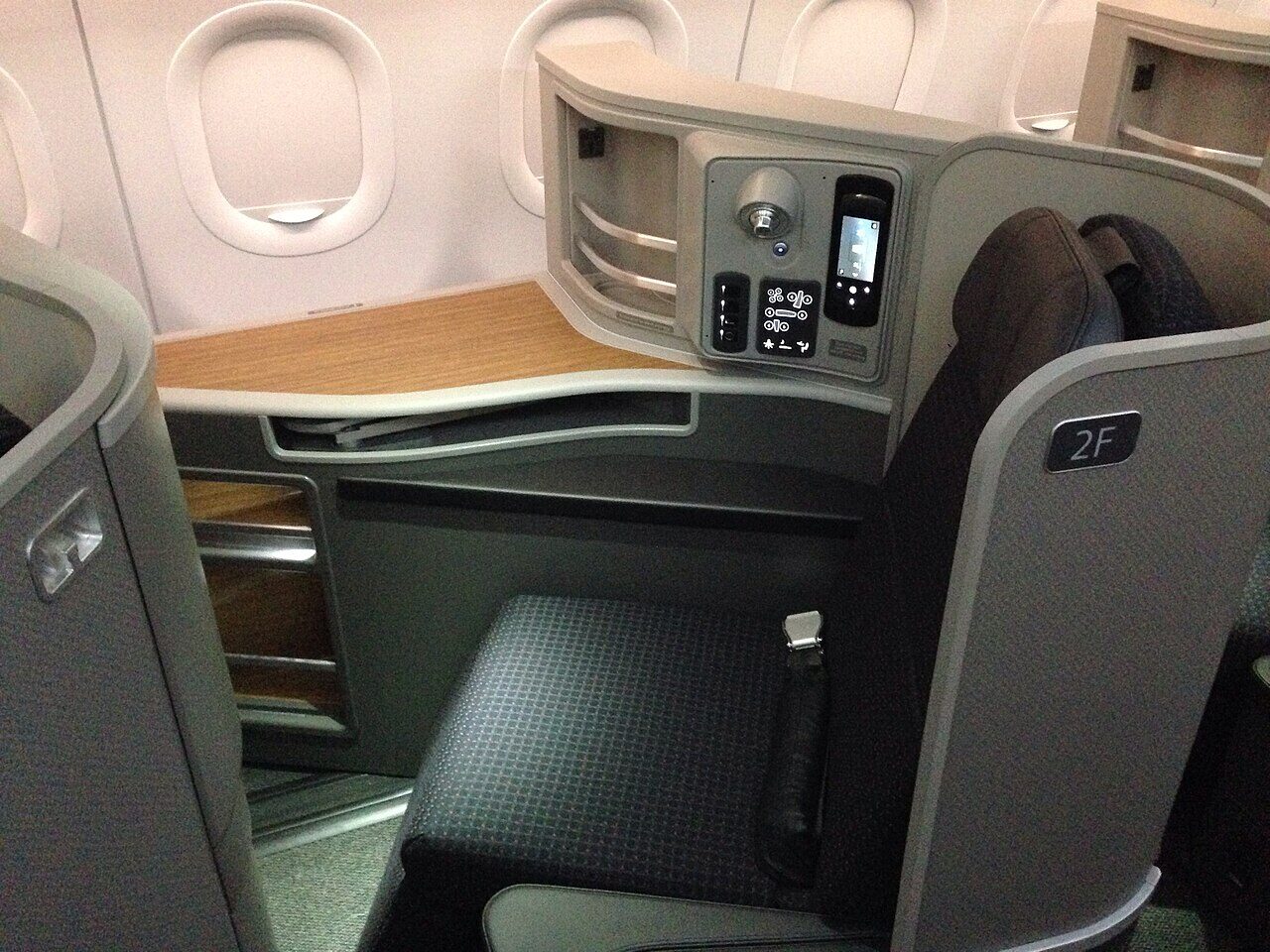
- Flagship Suite — the new business seat with a privacy door.
- Flagship Suite Preferred — the eight best seats in the Flagship Suite cabin. Confusingly, these are sold as a ticketed cabin called Flagship Business Plus.
That last one deserves emphasis because it trips up even experienced travellers. The seat is called Flagship Suite Preferred. The fare is called Flagship Business Plus. They are the same thing, and American uses both names on different pages of its own site.
What is on your aircraft right now
American publishes a cabin layout for every aircraft type. Here is what it currently lists, condensed:
| Aircraft | Premium cabins |
|---|---|
| A319, A320, A321, A321neo, 737-800, 737 MAX 8, regional jets | First (recliner) |
| A321 Transcon (A321T) | Flagship First + Flagship Business |
| A321XLR | Flagship Suite |
| 777-200 | Flagship Business |
| 777-300ER (original) | Flagship First + Flagship Business |
| 777-300ER (retrofitted) | Flagship Suite Preferred + Flagship Suite |
| 787-8 and 787-9 (original) | Flagship Business |
| 787-9P | Flagship Suite Preferred + Flagship Suite |
| E145 | No premium cabin at all |
Two aircraft types therefore exist in two completely different interior versions at the same time, and the booking engine will not always make the distinction obvious. Check the seat map, not the aircraft name.
The strangest number American publishes
American publishes seat width for every cabin. It publishes seat pitch only for cabins that do not lie flat; for every Flagship cabin, the pitch column simply reads “Lie-flat” instead of a figure. It publishes no bed length and no recline measurement anywhere.
Work through the widths it does publish and you find this: American’s domestic First recliner is 21 inches wide. Flagship Business on the A321 Transcon is 19 inches wide. The international-style lie-flat business seat on the premium transcon route is two inches narrower than the ordinary domestic first class seat you get on a flight to Phoenix.
The rest of the published widths run from 20.5 inches (Flagship Business on the original 777-300ER) to 21.9 inches (Flagship Business on the 777-200), with Flagship First at 21 inches on the A321T and 21.5 inches on the 777-300ER, and the new Flagship Suite at 21 inches, rising to a stated 21 to 22 inches for Flagship Suite Preferred.
Notice what that means. The outgoing Flagship First seat is wider than the incoming Flagship Suite that replaces it. What the Suite adds is a door, not space.
Flagship Suite: where the rollout actually stands
The Flagship Suite is American’s answer to a decade of complaints that its business class had fallen behind. It is a 1-2-1 reverse herringbone layout facing away from the aisle, with a sliding privacy door, wireless charging, and a 17.5-inch 4K screen.
787-9P
This was the launch aircraft, configured with 51 business seats — 43 standard Flagship Suites plus 8 Flagship Suite Preferred — alongside 32 premium economy and 143 economy seats. American says the Preferred seats offer 19 percent more bed space and 42 percent more living area than a standard Suite. Reviewers measured the standard suite bed at 79 inches, though American does not publish that figure itself.
The privacy doors work. The FAA granted full approval in mid-2025 and the doors were activated that summer; hands-on reviews since confirm they slide and latch, with a deliberate small gap at the top. The 787-9P has flown Chicago, Los Angeles and Philadelphia to London, Philadelphia to Zurich, and Dallas/Fort Worth to Brisbane.
777-300ER
The first retrofitted 777-300ER, registration N718AN, re-entered service on 2 September 2026 on New York JFK to Buenos Aires after roughly nine months in the shop. The rebuild is drastic: the aircraft went from 304 seats with 8 first and 52 business, to 330 seats with 70 Flagship Suites — 8 of them Preferred — 44 premium economy and 216 economy, and no first class at all. Business pitch dropped from 43 to 42 inches and Main Cabin Extra from 35 to 34 inches to make the arithmetic work.
American says all 20 of its 777-300ERs will be retrofitted during 2027. Independent observers think late 2027 is optimistic and early 2028 is more likely. The type flies to London, Tokyo Haneda, São Paulo, Buenos Aires and Sydney.
A321XLR
The A321XLR carries 20 Flagship Suites, 12 premium economy and 123 main cabin seats — a single-aisle aircraft with a doored business suite. The first was delivered on 22 October 2025 and the inaugural flight operated as AA3 from JFK to Los Angeles on 18 December 2025. The FAA cleared the suite doors on 18 July 2026, after which they were activated aircraft by aircraft through the autumn.
American’s own fleet plan projects 12 A321XLRs by the end of 2026 and 24 by the end of 2027, from an order of 40. The XLR is what replaces the A321T on premium transcontinental routes, which is precisely why Flagship First is disappearing: the aircraft taking over the route has no first class to sell.
Flagship Dining: renamed, reopened, and now open to business class
If you have read an evergreen guide to American’s lounges in the last few months, there is a good chance it is wrong, because two things changed in autumn 2026 and most pages have not caught up.
First, Flagship First Dining has been renamed Flagship Dining, and since 15 September 2026 it has been open to business class passengers, not just first. American’s own page now lists eligibility as Flagship First, Flagship Business Plus or Flagship Business on a qualifying flight.
Second, the Los Angeles room reopened on 6 November 2026 after roughly six years closed. Guides still describing LAX Flagship Dining as temporarily shut are out of date.
There are exactly three locations, and American has said it does not plan a fourth:
- Dallas/Fort Worth — Terminal D near gate D23, inside the Flagship lounge. Daily noon to 10 p.m.
- Los Angeles — Terminal 4, across from gate 40. Daily noon to 10 p.m.
- Miami — Concourse D near gate D30. Daily noon to 10:30 p.m.
The rules that catch people out are worth reading twice. Your departing flight must be marketed and operated by American on the same day, or before 6 a.m. the following day. Elite status alone does not get you in — access is based on your cabin, not your tier, so an Executive Platinum who enters the Flagship Lounge on status does not automatically qualify for the dining room. A domestic first class ticket does not qualify either, even on a transcontinental route out of Los Angeles, because the ticket has to be marketed as Flagship. Non-revenue airline tickets are excluded outright. Guesting is generous only on international Flagship First, which allows one guest; Flagship First transcon, Flagship Business Plus and Flagship Business allow none.
Qualifying international routes are those to and from the United States in Asia, Australia, Europe, the Middle East, New Zealand and South America — but American explicitly excludes Bolivia, Colombia, Ecuador, Guyana, Peru, Suriname and Venezuela. Qualifying transcon routes are JFK–LAX, JFK–SFO, JFK–SNA, LAX–BOS and LAX–MIA, plus a handful of long domestic Hawaii flights.
The JFK trap
At New York JFK Terminal 8, American’s premium lounges are not called Flagship Lounges at all. They are the Chelsea Lounge and the Greenwich Lounge, operated jointly with British Airways. JFK has no Flagship Dining room. If a guide tells you to book a table at JFK Flagship First Dining, it is describing something that no longer exists in that form.
American’s other Flagship Lounges are at Chicago O’Hare, Dallas/Fort Worth, Los Angeles, Miami and Philadelphia. A lounge at Charlotte was announced in August 2025 and is still, as of now, in development with no opening date; the new Charlotte Admirals Club will be 40,000 square feet, the largest in the network, with construction starting in late 2026. For more on how airline lounges compare across carriers, see our guide to the best first class airlines in the world.
Upgrades, and the change that annoyed elites in August
Complimentary domestic upgrades clear inside a window that widens with status: 24 hours for Gold, 48 for Platinum, 72 for Platinum Pro and 100 hours for Executive Platinum. American is careful to describe these as the earliest times an upgrade may be confirmed, not a guarantee. One companion on the same flight is included, and the request is automatic.
Two changes matter more than the windows:
From 25 August 2026, on the routes that have premium economy — the 777s, 787s and A321XLR — complimentary elite upgrades from the Main Cabin now clear into premium economy rather than business class. You move up one cabin at a time instead of jumping two. Business is still reachable if you hold a premium economy ticket, or on aircraft without a premium economy cabin. Systemwide upgrades were not changed and still take you from Main Cabin straight to Business, skipping premium economy.
Basic Economy tickets purchased on or after 18 May 2026 cannot be upgraded at all, by any method, including systemwide upgrades.
Systemwide upgrades themselves are awarded through Loyalty Point Rewards starting at 175,000 Loyalty Points, with additional grants at the two-million-mile Million Miler level and above. They are valid through the status membership year, which runs to 31 March of the following year.
What American does not tell you
We are not going to quote you a fare or an award price, because American does not publish either. There is no award chart and no published fare table for Flagship cabins, and any article presenting a precise number as the current price of an American first or business class seat is either modelling it or quoting a figure that has already moved.
The same applies to a handful of details that circulate confidently and have no primary source behind them. American does not publish seat pitch for any lie-flat cabin, bed length for any cabin, or recline figures at all. It does not break out how many 787-9Ps it operates, publishing only a combined 787-9 count of 33. It has never published a tail-by-tail schedule for the 777-300ER retrofit, so nobody outside the airline knows how many are done. And whether Flagship Suite Preferred now carries a surcharge is genuinely unresolved — it was free on a first-come basis as recently as late 2025, and several observers expected that to change.
If you want to fly Flagship First before it goes
You have a narrow window and it is closing from both ends.
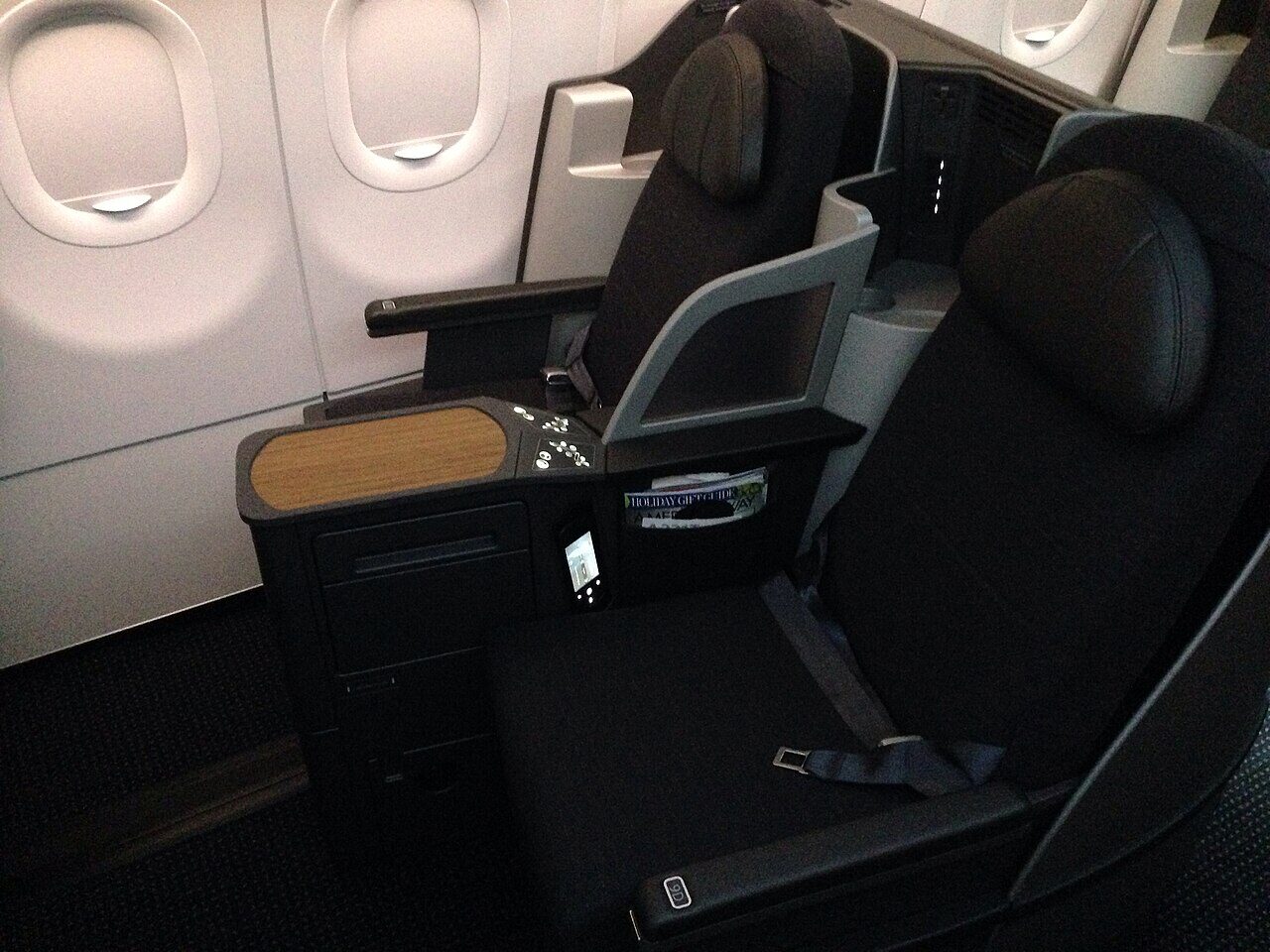
The A321T is still operating Flagship First today, in a 102-seat layout with 10 Flagship First seats in a 1-1 configuration across the first five rows, 20 Flagship Business in 2-2, and 72 economy. It flies Boston–Los Angeles, JFK–Los Angeles, JFK–San Francisco and JFK–Orange County. That is the last genuinely distinctive first class cabin American sells, and the 1-1 layout — one seat on each side of a single aisle — is something no other US carrier offers on a domestic route.
On the widebody side, unretrofitted 777-300ERs still carry eight Flagship First seats in rows one and two, but the aircraft is now almost entirely deployed internationally, and the cabin stops being sold for travel from 19 November 2026.
The honest summary is that American is trading a first class cabin for a better business class cabin, and for most travellers that is the right trade: a Flagship Suite with a door beats an older Flagship Business seat without one, and there will be far more Suites than there ever were first class seats. But if you specifically want the thing American is deleting, the clock is running. Compare it against what the competition still offers in our breakdown of business class versus first class, and against Delta One and United Polaris, both of which are running their own suite rollouts on different timetables.
Dates worth putting in your diary
- 19 November 2026 — Flagship First no longer sold on the 777-300ER.
- 1 March 2027 — AAdvantage programme year rolls over.
- 28 March 2027 — Flagship First no longer sold on transcontinental routes. American’s last first class cabin above business.
- 31 March 2027 — systemwide upgrades issued for the 2026–27 status year expire.
- During 2027 — all 20 777-300ERs scheduled for retrofit; the A321T fleet reconfigured to a standard domestic layout.
Image credits
Flagship First and Flagship Business on the A321 Transcon: photos by DearEdward (New York, NY), CC BY 2.0, via Wikimedia Commons.