
Los Cabos Tourism Board publishes its own list of the best all-inclusive resorts in Los Cabos. It names eleven properties. Not one of them is a hotel you would recognise as the top of the Cabo market.
One&Only Palmilla is not on it. Neither is Las Ventanas al Paraíso, Waldorf Astoria Pedregal, Four Seasons Costa Palmas, Montage, Nobu, Chileno Bay, Esperanza, Zadun or Park Hyatt Cabo del Sol. The destination’s own marketing organisation says it plainly on the same page: “Luxury in Los Cabos goes beyond the all-inclusive label.”
That is the thing to understand before you book. Los Cabos is the one major Mexican beach destination where the luxury tier and the all-inclusive model barely overlap. In Cancun, luxury brands are converting into all-inclusive. In Cabo they have mostly declined to.
The actual all-inclusive list
These are the eleven the Tourism Board names, with the tier it assigns them:
| Resort | Tier |
|---|---|
| Grand Velas Los Cabos | Luxury |
| Marquis Los Cabos | Luxury |
| Secrets Puerto Los Cabos | Adults-only |
| Breathless Cabo San Lucas | Adults-only |
| Pueblo Bonito Pacífica | Adults-only |
| Hyatt Ziva Los Cabos | Family |
| Dreams Los Cabos | Family |
| Hard Rock Hotel Los Cabos | Family |
| Royal Solaris Los Cabos | Family |
| Krystal Grand Los Cabos | Family |
| Hilton Vacation Club Cabo Azul | Family |
Note the eleventh entry. The Tourism Board lists Cabo Azul on its all-inclusive page and then states on that same page that it is not a traditional all-inclusive resort and offers optional food and beverage plans instead. When the destination’s own DMO contradicts itself inside a single list, it tells you how loosely the word is used here.
Grand Velas Los Cabos is the cleanest answer for a traveller who wants genuine luxury and genuine all-inclusive in the same booking. It describes itself as “a luxury all-inclusive resort” and sits at Km 17 on the Tourist Corridor. Garza Blanca Los Cabos, at Km 17.5, markets “elevated all-inclusive” but is absent from the Tourism Board’s list and does not say on its own site whether the all-inclusive plan is mandatory or optional. Le Blanc Spa Resort Los Cabos is an adults-only all-inclusive; its own website is not publicly reachable, and booking platforms disagree about whether it sits in Cabo San Lucas or San José del Cabo.
Pueblo Bonito states on its corporate FAQ that all its beach resorts “offer all-inclusive dining, drinks, activities, and more.” Read the verb carefully. “Offer” is not the same as “are,” and it is worth confirming at booking whether you are buying a plan or a default.
The fact nobody puts in a Cabo roundup
Most beaches in Los Cabos are not safe to swim at.
This is not a seasonal caveat or a rough-day warning. It is the structural condition of the destination. Cabo sits where the Pacific meets the Sea of Cortez with no protective reef, and the result is heavy shorebreak, undertow and rip currents along much of the coast — including directly in front of some very expensive hotels.
The municipality publishes a list of designated swimmable beaches, playas nadables. There are 23 of them in the entire Los Cabos municipality, stretching from Cerritos near Todos Santos all the way to Los Barriles on the East Cape:
Cerritos, El Corsario, El Médano, Las Viudas, Santa María, El Chileno, El Bledito, Palmilla, La Playa, La Fortuna, 9 Palmas, Los Frailes, Arbolitos, Cabo Pulmo, La Ribera, El Surgidero, Rancho Leonero, La Capilla, SPA Buenavista, Rancho Buenavista, Vista del Mar, La Gaviota and Los Barriles.
Now look at where the luxury hotels are. The Tourist Corridor — the 30-kilometre stretch between the two towns where most of the high-end inventory sits — contributes roughly five entries to that list: Las Viudas, El Chileno, El Bledito, Palmilla and Santa María. Costa Azul, El Tule, Cabo Bello, the Monuments stretch, Solmar and the entire Pacific face do not appear at all.
Five Los Cabos beaches hold the “Playa Limpia y Sustentable” certification, which requires restrooms, bins, information modules, ramps and lifeguards: Acapulquito, Las Viudas, Palmilla, Chileno and Santa María.
The flag system
Green means safe. Black or red means do not enter. The official tourism safety page warns that some beaches are “unsuitable to go swimming in the ocean due to rough surf, rip currents and undertows” — and then names none of them. The gap this article fills is institutional, not just editorial.
What the hotels themselves admit
The most useful confirmations come from the resorts, not the guidebooks:
- Pueblo Bonito’s corporate FAQ: “Our resorts facing the Pacific Ocean do not have swimmable beaches.”
- Pueblo Bonito Pacífica’s own FAQ: “due to strong currents, swimming is not permitted.” That is an adults-only luxury all-inclusive where you cannot enter the sea.
- Auberge’s Chileno Bay calls itself “one of Cabo’s only swimmable beaches” and markets an experience titled “Cabo’s Most Swimmable Beach.” A luxury brand advertising scarcity tells you how scarce it is.
- One&Only Palmilla refers to “swimmable shores” and the “swimmable waters of Palmilla Bay.”
- Four Seasons Costa Palmas claims “the largest swimmable beach,” with over two miles of shoreline on the East Cape.
And the pointed silence: Grand Velas at Km 17 and Garza Blanca at Km 17.5 — the two leading all-inclusives on the Corridor — say nothing about ocean swimming on their own sites and promote their pools instead. Neither Km 17 nor Km 17.5 appears on the municipal swimmable list. Draw your own conclusion, but ask the hotel directly before you book if swimming in the sea matters to you.
The practical consequence: in Los Cabos, the pool is the swimming. Budget for a resort with a serious pool complex, and treat ocean swimming as something you travel to — Chileno, Santa María, Palmilla or Médano — rather than something that happens outside your room.
Where to stay, by geography
Los Cabos is four distinct places and the airport is at one end of it.
- San José del Cabo — 15 to 25 minutes from SJD. Quietest, most walkable old town, art district, shortest transfer.
- The Tourist Corridor — 25 to 35 minutes. Where the luxury concentration sits. Mostly non-swimmable beachfront. You will need a car or taxis for anything.
- Cabo San Lucas — 40 to 50 minutes direct, up to 90 on a shared shuttle. Nightlife, the marina, the Arch, and Médano Beach, which is the destination’s main genuinely swimmable town beach.
- East Cape, including Costa Palmas at La Ribera — about 45 minutes. Swimmable, remote, and with essentially no all-inclusive product at all.
Corridor kilometre markers are the local shorthand and worth knowing: Montage at Km 12.5 on Santa María Bay, Chileno Bay at Km 15, Grand Velas at Km 17, Garza Blanca at Km 17.5, Las Ventanas at Km 19.5.
Getting there, and the arrivals hall
Fly into Los Cabos International (SJD). One warning that no resort will give you: in the international terminal, between customs and the exit doors, there is a corridor of timeshare and “transportation information” desks. The staff offer free or heavily discounted rides in exchange for attending a resort presentation that can consume half a day of your holiday.
The rule is simple. Real drivers and the official taxi kiosks are outside the exit doors. Anyone who approaches you inside the hall and asks where you are staying, what your budget is, or whether you are married is running a sales qualification, not an information service. Say no and keep walking.
Transfer options, as of late 2026, with the usual caveat that prices move with season and fuel:
- Shared shuttle to Cabo San Lucas: roughly $20–25 per person.
- Private transfer to Cabo San Lucas: from about $89 for an SUV up to four, to around $209 for a large van.
- Authorised airport taxi: roughly $75–115 per vehicle to Cabo San Lucas, $40–85 to San José del Cabo. Buy a printed ticket at the official kiosk; the airport does not publish rates.
- Rental car: around $100 a day once mandatory Mexican third-party liability insurance is included, plus a card deposit hold.
- Public bus (Ruta del Desierto) to Cabo San Lucas: about 100 pesos, pesos only.
- Uber, DiDi and inDrive do not do airport pickups in Los Cabos. They work for trips around town only.
For a sense of what the luxury tier charges for the same journey, Las Ventanas publishes its own transfer rates: $340 return for an SUV up to five, $440 for a luxury SUV, $500 for a Sprinter up to sixteen.
Taxes and fees: be sceptical of any number you read
This is the part of Cabo planning where we are going to be honest about what is not knowable from the public record.
Mexican IVA is 16 percent on the room rate. Baja California Sur levies a state lodging tax (ISH) that secondary sources list at 4 percent for 2026, though we could not confirm this against the state’s own Ley de Ingresos.
Los Cabos also charges a municipal environmental sanitation fee, the derecho de saneamiento ambiental, per occupied room per night. The legal basis is 70 percent of the daily UMA — the inflation-indexed unit Mexico uses for statutory amounts — which means it re-prices every February. The 2025 figure was 79.19 pesos, around $3.86. We could not locate an official 2026 figure, so treat any specific peso amount you see as potentially a year out of date.
There is also a Baja California Sur foreign-visitor fee, the Aprovechamiento al Turista Extranjero, reported at around 470 pesos per person per stay for foreign tourists over 12 who spend at least one night in the state, paid through a state platform. We are flagging rather than asserting it: the amount has been reported at both 350 and 470 pesos in different years, reporting disagrees over whether it is charged per night or per stay, the collection mechanism has changed from hotel-collected to online, and the industry has publicly challenged it as unconstitutional. We could not confirm it is still being collected as of November 2026.
The useful takeaway is not a number. It is this: ask your hotel for a full charge breakdown in writing before you arrive, and be sceptical of any Cabo article that states these figures with confidence, because the primary documents are not readily available online.
When to go, and the trade-off nobody mentions
The eastern Pacific hurricane season runs 15 May to 30 November, peaking in late August. Most storms form between late June and early October.
2026 was not a quiet year for Cabo. The eastern Pacific season ran above average in named storms and accumulated energy, and Hurricane Marie, a Category 2 in early September, directly affected Los Cabos — small vessels were barred from leaving port in San José del Cabo, classes were cancelled and several streets flooded. Tropical Storm Iselle and Hurricane Genevieve both sent dangerous surf and rip currents to the western peninsula earlier in the season. If you have read that 2026 was a calm hurricane year, that was the Atlantic, not the Pacific.
Month by month, using Mexico’s national meteorological normals for the Cabo San Lucas station:
| Period | Highs | Rain | Sea temp |
|---|---|---|---|
| Dec–Feb | 80–81°F | 5–7 mm | 70–72°F |
| Mar–May | 83–90°F | 0–1 mm | Warming |
| Jun–Jul | 91–94°F | 0–8 mm | Into the 80s |
| Aug–Sep | 93–94°F | 85–110 mm | 82–84°F |
| Oct–Nov | 87–92°F | 17–25 mm | Still warm |
The honest trade-off: March to May is the best weather window — warm, essentially rainless, no storm risk. But January and February, which have the most reliable blue skies and the whales, also have 70 to 72°F water, which is cold enough that a lot of people will not swim in it. August and September give you 82 to 84°F water and everything else wrong at once. If warm sea matters more than perfect weather, aim for late October and early November.
Whales: the 2026–27 dates are official
Mexico’s environment ministry publishes the whale-watching season by zone each year. For 2026–27, the Cabo San Lucas and Cabo Pulmo season runs 15 December 2026 to 30 April 2027. Other Baja California Sur zones including Bahía de Loreto and the Pacific lagoons run 1 January to 30 April 2027.
The rules are federal and enforced. Boats must keep below 5 knots in observation areas and 2 knots entering them; 60 metres’ distance for small boats, 80 for larger ones, 240 for boats queueing; a maximum of four boats per group of whales and 30 minutes of observation. Swimming with whales, jet skis and kayaking with whales are prohibited. The Cabo San Lucas port zone and a 2-kilometre radius around El Arco are restricted. Authorised boats display a visible identification marker — check for it before you board. Humpbacks and greys are the species you will see; whale sharks appear roughly December to April.
What is coming, and what it tells you
The Los Cabos pipeline through 2029 is substantial and almost entirely European Plan luxury on the Pacific and the East Cape:
- Park Hyatt Los Cabos at Cabo del Sol — open since late 2025.
- Amanvari, Costa Palmas, East Cape — targeted spring 2026.
- St. Regis Los Cabos at Quivira — targeted 2026.
- Soho House Los Cabos, Cabo del Sol — 2026, reduced to 15 keys plus residences.
- Grand Hyatt Los Cabos at Oleada — end of 2026.
- Conrad Los Cabos, Oleada — by 2027.
- SIRO Palmilla — 2027.
- Delano East Cape and Raffles Estera East Cape — 2029.
None of these is announced as all-inclusive. Several have already slipped from their original dates, so verify before booking around one. The structural point stands: the gap between Cabo’s luxury tier and its all-inclusive tier is widening, not closing.
Three resorts commonly mis-sold as Cabo all-inclusives
Rancho Pescadero fails on three counts at once, and it is the single best illustration of how loosely this category is sold. It is now Kimpton Mas Olas Resort & Spa; the old web address redirects. It is in El Pescadero near Todos Santos, on the Pacific, a different municipality and “one hour from Cabo” by its own description. And it is not all-inclusive — its own site advertises “no resort fee” and lists included amenities à la carte. It is a perfectly good hotel. It is not a Cabo all-inclusive.
Pueblo Bonito Sunset Beach is sold by at least one major online agency with “All Inclusive” in the property name. It is absent from the Tourism Board’s all-inclusive list, where only Pacífica appears, and Pueblo Bonito’s own language is that its resorts “offer” all-inclusive. It also sits on the Pacific side, where the company itself says the beaches are not swimmable.
One&Only Palmilla gets miscoded as all-inclusive by aggregators because its promotional packages include breakfast and a resort credit. It is a European Plan hotel with six à-la-carte dining options.
So should you book an all-inclusive in Cabo?
If what you want is a genuine luxury all-inclusive, Grand Velas is the clearest fit and the Tourism Board agrees. If you want adults-only all-inclusive, Secrets Puerto Los Cabos, Breathless and Pueblo Bonito Pacífica are the real options — with the caveat that at Pacífica you will not be entering the ocean.
But if the reason you are searching for an all-inclusive is that you want the top of the market with nothing to think about, Cabo is the destination where that instinct leads you away from the best hotels rather than towards them. The properties people travel to Los Cabos for are European Plan, and they are European Plan on purpose. Consider booking one and treating the restaurant bills as the price of the address — or go to Cancun or Punta Cana, where the all-inclusive product and the luxury product actually line up.
Our guide to the best luxury all-inclusive resorts in Mexico covers the national picture, and the One&Only Palmilla review covers the other side of the Cabo argument.
Image credits
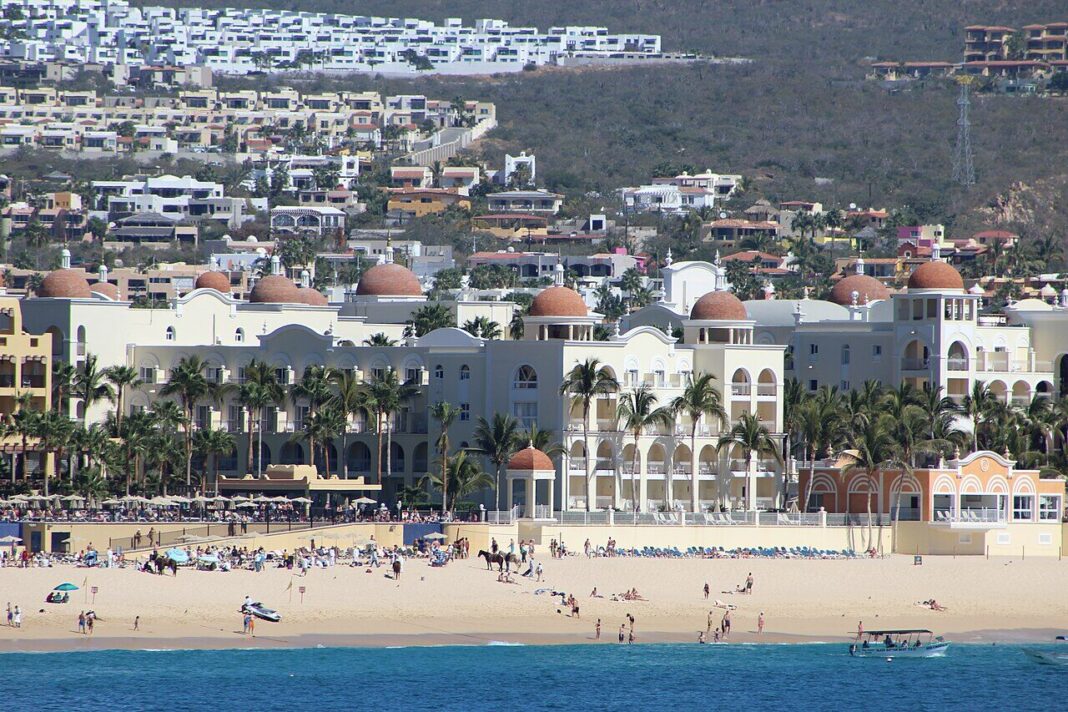
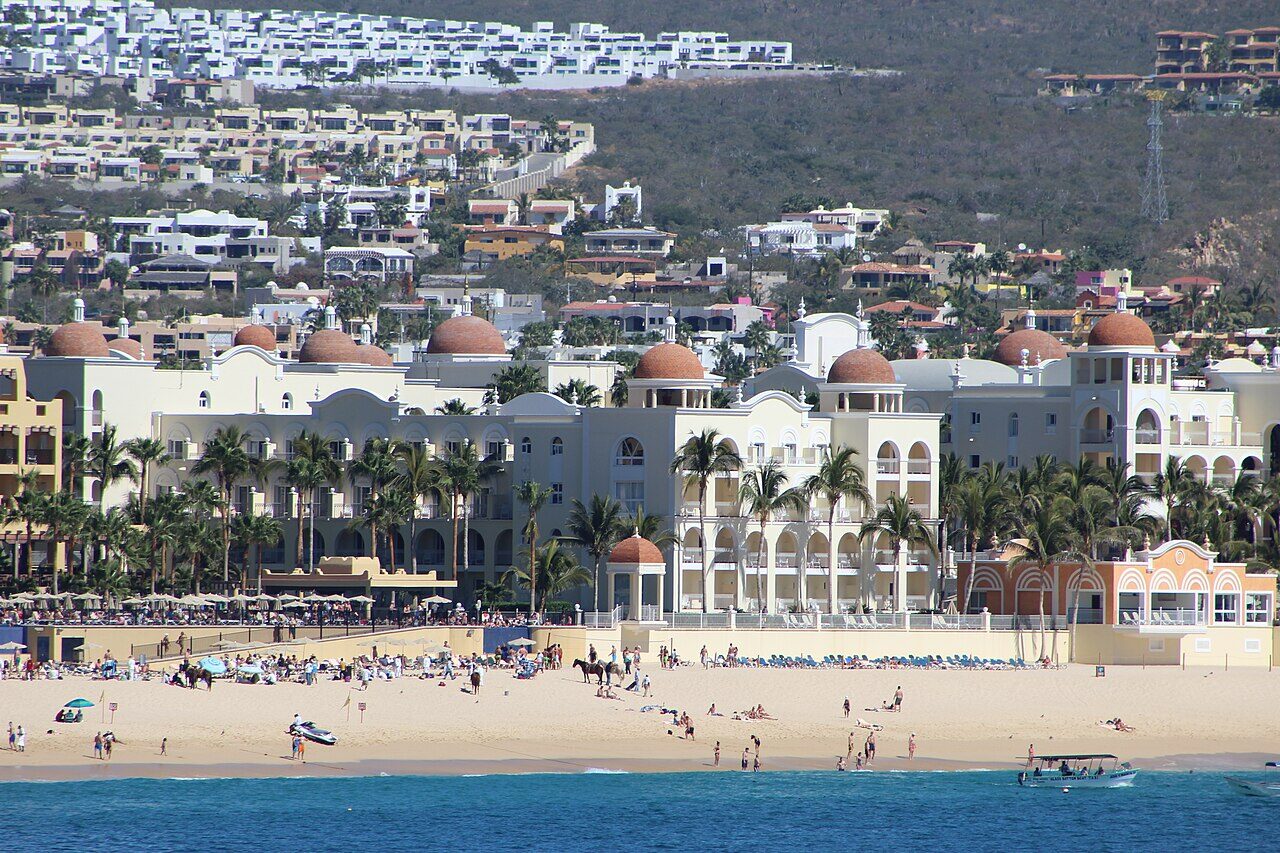
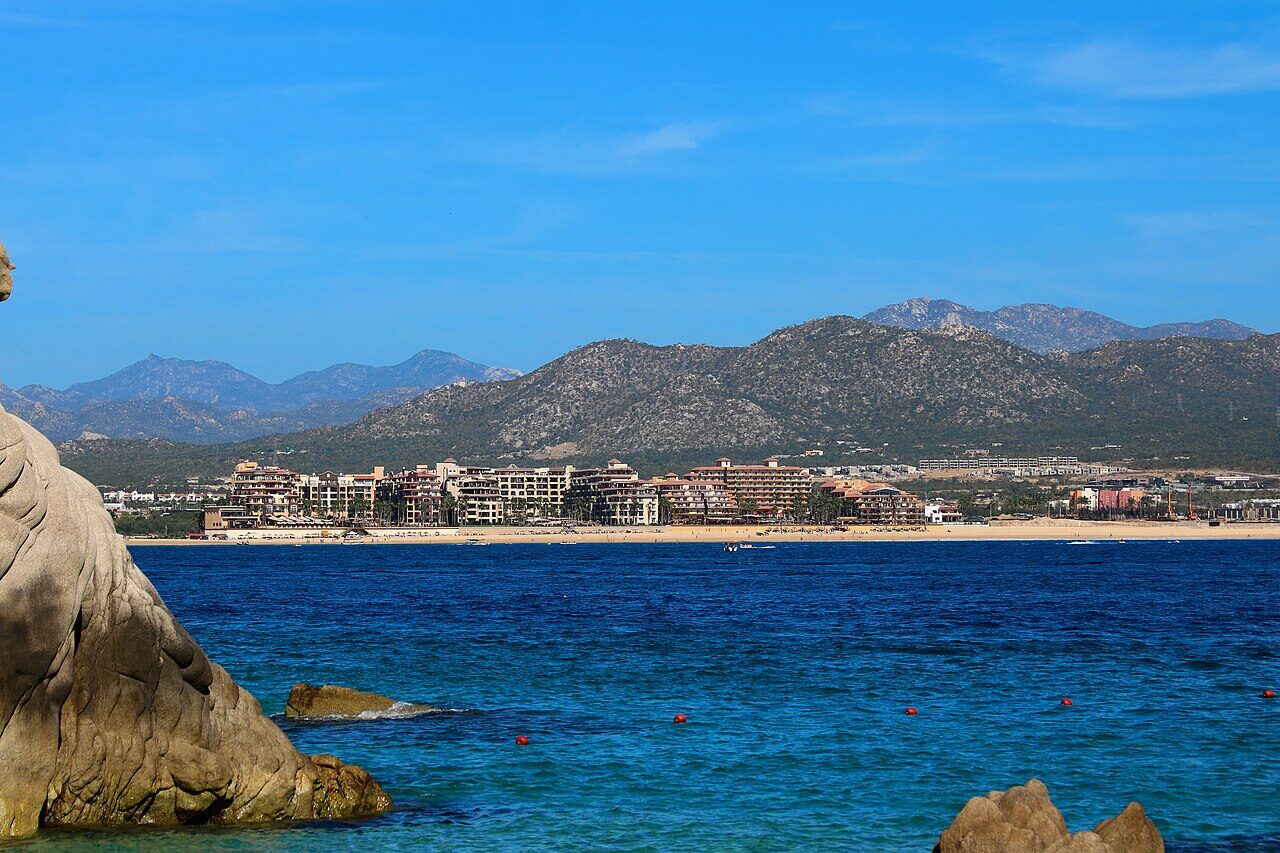
Riu Palace Cabo San Lucas: photo by Shane Sm, CC BY-SA 3.0. Cabo San Lucas shoreline: photo by Rafael Saldaña, CC BY 2.0. Both via Wikimedia Commons.